Prince of darkness, p.1
Prince of Darkness, page 1
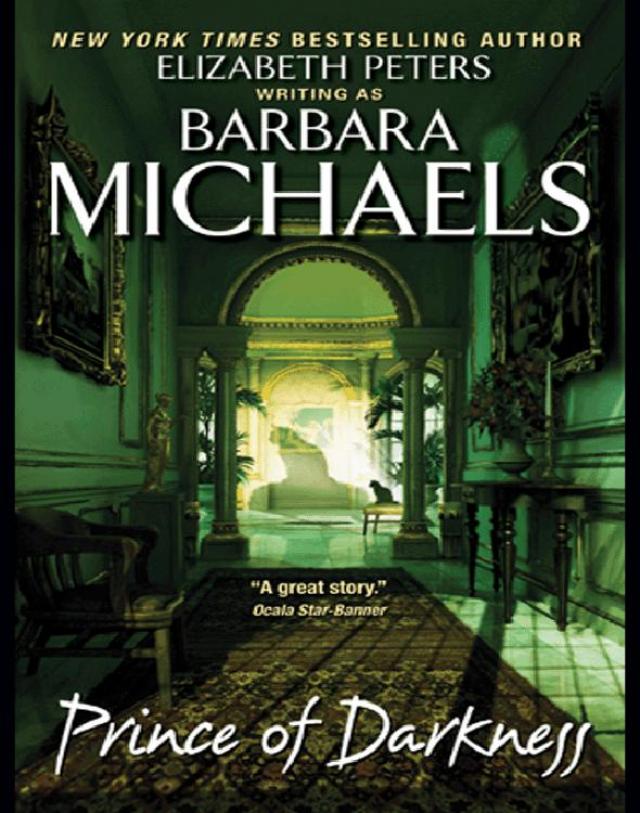


Prince of Darkness
ELIZABETH PETERS
WRITING AS
BARBARA MICHAELS
Contents
Meet/Huntsman/Quarry
Prologue: Meet
Part One: Huntsman
Chapter 1
Chapter 2
Chapter 3
Chapter 4
Chapter 5
Chapter 6
Chapter 7
Chapter 8
Part Two: Quarry
Chapter 9
Chapter 10
Chapter 11
Chapter 12
Chapter 13
About the Author
Praise
Books by Barbara Michaels
Copyright
About the Publisher
Meet: Place where hounds and field gather before a hunt
Huntsman: Generically: one who hunts. Specifically: one who directs, controls and assists hounds in their pursuit of game. (“Hunter” is used only in connection with the horse and never the rider.)
Quarry: Hunted animal
From The Horseman’s Dictionary, by Lida Fleitmann Bloodgood and Piero Santini. (E. P. Dutton and Co., New York, 1964.)
PROLOGUE
Meet
THE TEASHOP WAS LOCATED ON ONE OF THE DINGY discouraged streets on the wrong side of the Thames, not far from Waterloo. Its interior appearance matched the neighborhood. Torn plastic mats failed to conceal the streaked grease on the tabletops, and the floor was strewn with the crumbs of a thousand vanished biscuits. The afternoon sun of September fought its way in through windows begrimed with dust.
It was early in the day for the peculiar meal which only the British could have invented; the hour, and the unprepossessing atmosphere of the shop, perhaps explained why there were only three people in the place: two customers, at a back table, and a drowsy-looking waitress, whose teased blond hairdo was pressed up against the transistor radio which filled the room with the jerky rhythms of modern dance.
The two men who sat hunched over untouched cups of a suspicious-looking dark-brown liquid were in complete harmony with their surroundings. The elder of the two was a tiny man, wizened and bent like a gnome. His sharp nose would one day meet his pointed chin, if the teeth in between abandoned their posts. His eyes were small and close set, and heavily shuttered, not only by drooping lids, but by a kind of opacity; the thoughts that burgeoned inside the domed head, sparsely covered by graying hair, would never be read through those windows. He wore a chartreuse-and-burgundy tweed jacket and a cap of the sort that is associated with gentlemen who frequent the race tracks. His hands were small and delicately shaped.
The younger man’s most conspicuous feature was a head of thick flaxen hair which hung in ragged locks over his ears and brushed the back of his collar. The collar was frayed; the suit jacket was shiny with age and seemed not to have been constructed for its present owner. Though slightly built, the man was too thin even for his normal bone structure. His skin had the distinctive grayish pallor which innocent observers might have interpreted as the result of long illness, or—more accurately—long confinement away from the sun. There were good bones under the tight-drawn skin of his face, but his features were marred by their expression. The blue eyes were set too deeply in their sockets, the mouth was too tight, the jaw heavy and arrogant. Like his face, his hands bore the signs of his recent activities; long-fingered and slender, they were heavily calloused, with broken nails and ragged cuticles.
He picked up his teacup clumsily, as if he were not accustomed to handling anything so comparatively fragile as the thick white china, took a sip, and grimaced.
“No wonder so many people are emigrating.”
“Sure, and it wasn’t for the beverage that a good Irishman like meself would suggest meeting here.”
“Irishman, hell. You haven’t seen Dublin for fifty years. And do drop the phony accent, can’t you?”
“Limerick,” said the older man equably. “And be damned to you. Seems to me you’ve picked up a bit of an American twang yourself.”
“My late—er—roommate was an American.”
“And what would he be doin’ so far from home, I wonder?” cooed the older man. He met his companion’s cold stare and bared his teeth in a grin. “Allow me me little eccentricities, lad. So long as I do the job you’ve no ground for complaint.”
“I’ll give you that much,” the younger man said grudgingly. “You’re the best in the business. That’s why I got in touch with you.”
“That and old friendship, eh?” The older man grinned more broadly, and his companion responded with a slightly upward curve of the corners of his mouth. It could hardly have been called a smile, but it was evidently the closest approximation he could manage to that expression, and the slight relaxation of his taut shoulders indicated that his mood was improving.
“Hardly friendship,” he said. “You seem to have flourished since those days, Sam. You’re looking older and more wicked than ever.”
“I can’t say the same for you. How long is it you’ve been…”
“Back?” The younger man supplied gently. “Six days.”
“Six, is it? You wired me four days ago.”
“Yes.”
“In a hurry, weren’t you?”
“Yes.”
Sam sucked his lower lip. He gave his companion a sidelong glance.
“And what have you been doin’ with yerself since then?”
“This and that.”
“You’ve not spent your time in Savile Row, that’s for certain,” Sam said, with a glance at his companion’s shabby suit. He gave his own lapel a complacent tug. “Nor at your barber.”
“What’s that supposed to mean?”
“Why should it mean anything, then?”
His companion gave him another grudging smile.
“Everything you say means something, you old devil. Are you suggesting I get my hair cut, or the reverse?”
“Ah, it’s a sad world when a man can’t make a casual remark without starting nasty suspicions.” Absently Sam took a sip of tea, choked theatrically, and settled back. “The reverse. You’re right up with the current fashions. Why don’t you grow a beard?”
“No beard. All right, Sam, let’s have it.”
Sam sighed profoundly.
“You didn’t give me much time, you know.”
“You never need much time.”
“In this case I didn’t. Most of it’s public knowledge.” Sam sat up straighter. When he spoke, his accents were unaffected, average American.
“Name of Katharine More. Dr. More. It used to be Moretszki, in case you didn’t know.”
“She changed it?”
“Not she. She’s got a towering pride, but not of that variety. The grandfather changed the name when he came from Russia in the eighteen eighties. He proceeded to do two impressive deeds: make a fortune in real estate and engender twelve children. The lady you’ve inquired about is the daughter of the second son, Carl. By one of those odd quirks of fate which occur in the best of families, she is the only surviving descendant of that prolific old gent.”
“Which makes her the surviving heir to the prolific old gent’s money.”
“Precisely.” Sam shot a keen glance through scanty lashes at the other man’s face; it was impassive as stone. He continued.
“The money went, in actual fact, to the eldest son, Stephan. He had a stepdaughter, child of his wife’s first marriage, but no offspring of his own. So the money went to Kate.”
“Kate? Not Shakespearean, I hope.”
“I think of her that way,” Sam said, with hideous sentimentality. His companion winced perceptibly. Sam smirked. “Indeed, but there are suggestions of the shrew. The lady is fairly young—late twenties—very rich, very intelligent—”
“Please.” The younger man raised a peremptory hand. “Don’t say very beautiful.”
“Well.” Sam masticated his lower lip thoughtfully. “That she isn’t. Not that her face would stop a clock, mind, but she’s the image of the lady professor, which is what she was. Everything but the horn-rimmed glasses. She has twenty-twenty vision.”
“You would know that.” The younger man sounded resigned. “Well, I’ve never believed in those films anyhow.”
“Which films? Oh, I get you; the ones where the frigid old bag takes off the horn-rimmed specs in the last reel and turns out to be Sophia Loren. No such luck, my boy. But three or four million bucks should gild even a withered lily.”
“You’re a dirty-minded old man entirely,” said his companion, in a vile imitation of a brogue. “Professor of what?”
“Assistant prof, to be precise. Of Sociology. Her field is folk-lore and superstition, ethnic survivals in isolated communities, et cetera. She’s written one book, on superstition and witchcraft in America. It’s been compared with Margaret Murray’s work on the witchcraft problem, but is more highly regarded by the scholarly reviewers; traces the cult of—”
“Is there anything you don’t know?” The younger man ran a hand through his shaggy hair.
“That’s my business, me boy. Information.”
“Well, you needn’t give me a synopsis. I’ve read Murray’s books, as it happens. She claims, I believe, that the witchcraft of the Middle Ages was the remnant of a prehistoric European religion which survived into late times. The horned god, fertility rites, and so on.”
“That’s right. Your girl friend has carried the idea one step further. She thinks the Old Re ligion still survives.”
“Oh, it does, it does,” the younger man murmured. “The powers of darkness are considerably stronger than the powers of good. What student of world affairs could doubt that? All right, Sam, let us not philosophize. Is the lady still professing? Or professoring?”
“No, she quit after she inherited her petty millions. Retired to the old family homestead.”
“Which is where?”
“It’s all in my report.” Sam indicated the sheaf of papers which lay on the table between them. “Middleburg, Maryland, U.S.A. No, I’m not kidding. It’s a misnomer, though; the town is an unusual place.”
“Go on.”
Sam settled back in his chair, comtemplated his tea balefully, and settled for a cigar. When it was lit he blew out a cloud of dark smoke that made his companion wrinkle a fastidious nose, and began his lecture.
“Middleburg is one of the oldest settlements in the States, goes back to the early seventeenth century and Lord Baltimore—you’ve heard of him? Religious freedom, Catholic English fleeing persecution, all that stuff. Well, so the town sat there, peacefully rotting, for three hundred years. About thirty years ago it was discovered by the overflow gentry from Baltimore and Washington. They thought it was quaint, and I guess it was; if you like quaintness. Now the place is transformed, but selectively. The idle rich bought up the old houses and restored them, and built big estates outside town. They’ve got a committee which supervises new construction; I hear you can’t build a house in the area for under a hundred thousand, but that may be exaggerated. Slightly exaggerated.
“The citizens are an ungodly mixture. Along with the inbred descendants of the original boys and girls you’ll find some of the bluest blood money can buy. The country club is so exclusive that the President—of the U.S., that is—was recently blackballed. It’s huntin’ country and drinkin’ country. I don’t know about merrie olde England, but in the States those two often coincide. How are you at riding? Horses, I mean.”
“Fair.”
“Oh, that English modesty,” Sam said, beaming. “What about hunting? Riding to hounds, I believe it’s called.”
“I’m not awfully keen these days on hunting things,” the younger man said. His tone was calm, even pleasant; but a shiver went up Sam’s well-insulated backbone.
“Well, then,” he said, studiously contemplating his stone-cold cup of tea, “we’ll have to find some other way for you to ingratiate yourself. The lady doesn’t hunt, in any case.”
“Doesn’t she?”
Sam looked up quickly, but his companion’s face was as affable as it ever permitted itself to be.
“Want more tea?” he asked, more disturbed than he cared to admit.
“God forbid.”
“All right, five more minutes and you can be on your way to wherever you’re going, and I’ll be on my way to—wherever I’m going. Where was I? Oh, yes, the town. If you want to know more about it, there’ve been articles in some of the glossier magazines. They like their privacy, in Middleburg—for a variety of reasons, probably—but they can’t keep all the curious out, and it is a strange place, with the mixture of old and new. The old boy, Kate’s Uncle Stephan, was one of the people who bridged the gap. He had the dough, and his mother was a daughter of one of the old families. A Device, no less. All right, shrug, but in Middleburg that means something. Uncle Stephan was a weirdo himself. Didn’t marry till late in life, a widow with a child. He brought the kid up after his wife died, but never officially adopted her; that’s why the dough went to Kate when he kicked the bucket. She’s got the girl living with her now. They tell me she’s quite a dish.”
“Your slang is at least twenty years out of date. All right, you’ve given me a picture of the lady, and a damned unattractive one it is. What about her weaknesses?”
“Rumor says she hasn’t any.”
“Rumor. What about you?”
“A compliment, is it?” Sam grinned. “Praise from Caesar…I’ll admit I’ve found a few weaknesses. For one, the doctor has gone off the deep end.”
“Which one?”
“Well, you might call it lunatic-fringe scholarship, or just plain stupidity. She’s come to believe in her own subject, or at the least she’s doing some curious research.”
“Sticking pins in waxen images?”
“She may be, for all I know. Spiritualism, at least; and not the usual psychic bit, holding hands around a table in the dark. ’Tis a cult of some kind, with false priests and rituals. She has meetings in her house.”
“Charming. I used to dabble in magic myself, in my ill-spent youth.”
“Well, that’s a possible lead. If, indeed, it’s winning the lady’s confidence that you’ve got in mind….” He paused, his odd opaque eyes wide in pretended innocence. His companion’s face became, if possible, even blanker. Sam seemed to find in this the answer he expected; his voice had a hint of satisfaction as he continued.
“To the most popular and attractive weakness of the flesh the doctor seems to be impervious. Like all these brainy women, she despises men. However”—Sam lifted one dainty forefinger and wagged it in front of his companion’s amused face—“there was one weak moment, about two years back. When she fell, she fell hard. The whole town knew about it; and, my God, how the old ladies’ tongues wagged. Not that Middleburg isn’t as susceptible as any town to the good old human habit of casual adultery. But middle-class Americans are a hypocritical lot; they like to have the game, but not the name. Hypocrisy is not one of the doc’s weaknesses; in fact she seems to enjoy rubbing people’s noses in unpopular facts. Naturally, they responded by hating her guts.”
“Naturally.”
“Well, that’s irrelevant. What may help you is the fact—mark this—that the lucky fellow somewhat resembled you.”
The younger man made a rude noise.
“Not the old double routine, Sam. That isn’t done nowadays.”
“No, no, nothing so unlikely. ’Tis said that every man has an exact duplicate of himself walking the world; but how many people d’you know who’ve actually met theirs? I was speaking of a general type. Slight build, fair hair and—this is important—an Englishman.”
“Why important?”
Sam leaned back in the chair and assumed the position he favored for lecturing. The sunlight had deepened to bronze; in the back of the teashop shadows gathered.
“I suppose you’re too young to know these things,” he said tolerantly, ignoring his companion’s raised eyebrow. “You see, me boy, women aren’t logical. Vessels of pure emotion they are, poor darlings; and their emotions tend to get fixed on particular types. No doubt the Freudians could explain it all in terms of father images. Unlike ourselves, the ladies—bless ’em—are not so much impressed by the important physical features as by minor characteristics like hands, voice, hair color, and so on. And you needn’t be lookin’ at me with your eyebrows like that. A lady friend of mine explained it all to me, once upon a time.”
“A lady friend of yours?” the younger man said incredulously.
“Yes, indeed.” Unoffended, Sam smiled complacently. “Didn’t I say that they were illogical little creatures? It was me hands that won her heart; me hands and the lovely shape of the back of me neck.”
He rubbed the last-named feature fondly.
“How very poetic.”
“Yes; I’ve me sentimental side, though few ever see it.” Sam sighed deeply and then got back to business. “You’ll see the implications. Mind, I’m not claiming the resemblance will bring the lady rushing to your arms; but you’ve a better chance of being well receved than if you were tall and dark and heavy-set.”
“Puts me right in there with about half the men in the world,” the younger man agreed sarcastically.
“A quarter,” Sam said pedantically. “Tall and fair, tall and dark—”
“The redheads further confuse your categories. How many million fortunate males share my admirable characteristics, I wonder?”