

Crampton hodnet, p.1
Crampton Hodnet, page 1


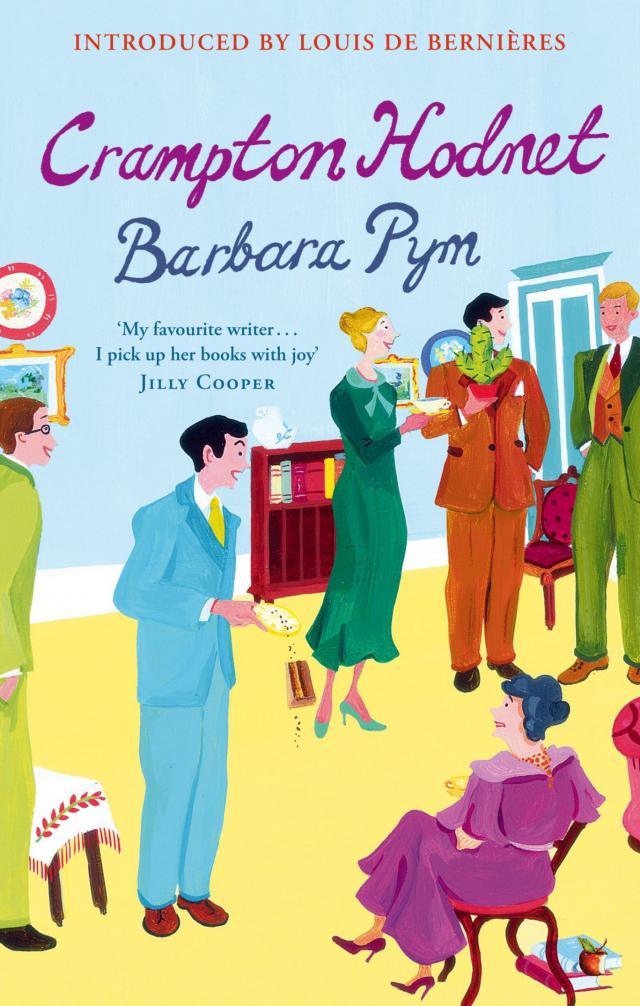
VIRAGO MODERN CLASSICS 568
Barbara Pym
Barbara Pym (1913–80) was born in Oswestry, Shropshire. She was educated at Huyton College, Liverpool, and St Hilda’s College, Oxford, where she gained an Honours Degree in English Language and Literature. During the war she served in the WRNS in Britain and Naples. From 1958–74 she worked as an editorial secretary at the International African Institute. Her first novel, Some Tame Gazelle, was published in 1950, and was followed by Excellent Women (1952), Jane and Prudence (1953), Less than Angels (1955), A Glass of Blessings (1958) and No Fond Return of Love (1961).
During the sixties and early seventies her writing suffered a partial eclipse and, discouraged, she concentrated on her work for the Institute, from which she retired in 1974 to live in Oxfordshire. A renaissance in her fortunes came in 1977, when both Philip Larkin and Lord David Cecil chose her as one of the most underrated novelists of the century. With astonishing speed, she emerged, after sixteen years of obscurity, to almost instant fame and recognition. Quartet in Autumn was published in 1977 and was shortlisted for the Booker Prize. The Sweet Dove Died followed in 1978, and A Few Green Leaves was published posthumously. Barbara Pym died in January 1980.
Also by Barbara Pym
Some Tame Gazelle
Excellent Women
Jane and Prudence
Less than Angels
A Glass of Blessings
No Fond Return of Love
Quartet in Autumn
The Sweet Dove Died
A Few Green Leaves
An Unsuitable Attachment
An Academic Question
Civil to Strangers
Copyright
Published by Hachette Digital
ISBN: 978-0-74812-637-8
All characters and events in this publication, other than those clearly in the public domain, are fictitious and any resemblance to real persons, living or dead, is purely coincidental.
Copyright © Barbara Pym, Hilary Walton 1985, Hazel Holt 2004
Note copyright © Hazel Holt 1985
Introduction copyright © Louis de Bernières 2012
All rights reserved. No part of this publication may be reproduced, stored in a retrieval system, or transmitted, in any form or by any means, without the prior permission in writing of the publisher.
Hachette Digital
Little, Brown Book Group
100 Victoria Embankment
London, EC4Y 0DY
www.hachette.co.uk
Contents
Also by Barbara Pym
Copyright
Introduction
Note
1: Sunday Tea Party
2: The Clevelands
3: A Safe Place for a Clergyman
4: Miss Bird
5: The Vicar of Crampton Hodnet
6: An Afternoon in the Bodleian
7: Mr Latimergets an Idea
8: Spring, the Sweet Spring
9: Ballet in the Parks
10: Respect and Esteem
11: Love in the British Museum
12: Conversation in a Tool Shed
13: Edward and Mother Give a Tea Party
14: Thoughts at a Lecture
15: Advice for Mrs Cleveland
16: Mr Latimer’s Holiday
17: A Confrontation
18: A London Visit
19: An Evening on the River
20: An Unexpected Outcome
21: The Road Home
22: The Prodigal Returns
23: Old Friends and New
Jane and Prudence
INTRODUCTION
Crampton Hodnet is a novel with a most intriguing and unusual title. One’s first reaction upon seeing it is to think: ‘What on earth can this be about?’ Anyone English would suspect straight away that it must be about a picturesque village in one of the rural counties – such a name is on a par with Piddletrenthide, Thornham Parva or Blisworth. The village turns out to be entirely invented, an improvised lie on the part of a clergyman in the novel, who does not want people to know where he has really been. Incidentally, Hodnet is a village in Shropshire, the county in which Pym was born, and Crampton was her middle name.
It may seem strange that a novelist should write a perfectly good novel and then never get round to having it published. Writers often sit on their work like this, however, and it can happen that a book goes through several drafts over a period of twenty years or more. If you feel that it is not quite right, or could be improved, or has missed the tide, it is natural to withhold it and think of reworking it later. Pym seems to have felt that Crampton Hodnet had missed the tide.
She began to write it shortly after the outbreak of the Second World War, and had finished it by April 1940. However, she obtained war work in the censor’s office in Bristol, and then fled a very painful passion by joining the WRNS, a job that took her to Naples in 1944, where one of the naval officers of her acquaintance became material for the character of Rocky Napier in Excellent Women. Crampton Hodnet has nothing to do with the war or with the way that the world had suddenly changed, and it must have seemed to Pym to have become an irrelevance. She might have thought of it as juvenilia, or an apprentice-piece. After the war she worked at the International African Institute in London, and edited the journal Africa, thus moving her even further away from the little world she had created in her unpublished novel.
Time and taste move on, and nothing travels in the same direction for very long. In retrospect it seems clear that Crampton Hodnet sits comfortably beside the six novels that constitute Pym’s early career in writing, and that the fact that it seemed dated when first written is no longer relevant seventy years later. The book has not in fact dated. The distance given by time has shifted the perspectives so that what seemed beside the point in 1944 now fits in where it had seemed not to, like a new building erected in an established garden that only looks exactly right many years later.
It is frequently said of Pym that her novels seem slight and even trivial, but actually are not. They are often about genteel people living in straitened circumstances, and there are plenty of Anglican clergy. Crampton Hodnet is very specifically set in north Oxford, and the novel will have particular resonance with people who know it, who will immediately be familiar with Magdalen Bridge or the Bodleian Library.
Crampton Hodnet is rescued from obscurity by the fact that it is about characters who immediately become real, and are very human indeed. At least three of them feel that their lives are going nowhere. One is resigned; she is the only one with much common sense or acuity, but she has a lowly opinion of herself, and finds it terribly disillusioning, but also rather entertaining, that an Anglican clergyman can turn out to be a liar. This clergyman wonders whether or not he should settle for second or third best. A don elopes with a student who really does turn out to be ‘a cold fish’ rather than a last, fabulous, incandescent passion. There are two outrageously camp gay characters who adore spreading scandal and causing trouble; the writing about them is perfectly comic. There is a woman in middle age who no longer gives a damn about either her husband or the metaphysical poets that fired her in youth, and another who sees herself as a kind of grande patronne, who really knows what’s what and what should be done. What particularly strikes this reader is the sense of stifled and unrequited passion, the unspecific yearnings on the part of people who know that their lives could have been, or still could be, so much more interesting and meaningful. One character does not have the resources or the energy or the courage to do anything about it – perhaps because she is actually quite content as she is. Our eloper does do something grand and ambitious, but it doesn’t work out, and he seems fairly relieved after all. His partner in crime, who thinks she has been in love, turns out to be pathetically frightened of what being in love leads to. A third character unexpectedly falls in love, and is exalted in a way that only falling in love can achieve. The characters are pathetic and ridiculous, each in their own way, but Pym’s mockery of them is entirely affectionate and her psychology is astute. Her humour is barbed, but sympathetic and ironic, the humour of someone English who sees how peculiar the English are, in particular the English of the unspectacular middle class, who are rather like Oxford, in which ‘Everything went on just the same … from year to year. It was only the people who might be different. The pattern never varied.’
Crampton Hodnet is a novel with one happy ending and some not-with-a-bang-but-a-whimpers. The reader might be disappointed by these outcomes were it not that the characters themselves seem very satisfied with them, and it is just possible that Miss Morrow might find happiness and satisfaction in the fictional meta-life hereafter, possibly with the curate who replaces Mr Latimer in Miss Doggett’s household, and that Anthea will find another Simon, Freddie or Patrick with whom to fall in love. Fortunately the reader’s pleasure lies not in the outcomes, but in the reading. The book is crammed with witty aperçus that make me wonder whether Pym had been a fan of Oscar Wilde in her youth. The difference is that Wilde’s humour is pointedly outrageous, and Pym’s is more subtle and truthful.
I remember English people who were just like these characters, and I still come across them. They are the kind of people who keep the village halls running, volunteer to manage the village shop, work one morning a week in a charity shop, and arrange for someone mildly famous to open the fete. We should always assume that they are full of yearnings and longings, because they almost certainly are. The people might be different, but the pattern never varies.
I thi nk that Pym fell out of fashion for a very long time because new literary tastes developed that seemed to leave her behind. The likes of Kingsley Amis came along; there were Angry Young Men; the French existentialists were transforming the way that intellectuals perceived the world; there were those who wanted to write about the difficult lives of working class people. Attention shifted away because a new snobbery developed that assumed that genteel people were not real people who led real lives worth exploring, that they were somehow less completely human than others. In particular, tastes became very metropolitan. There was more verbal violence, and humour slowly became more cruel. Characters didn’t take muddy walks any more, or worry about whether or not to take the last biscuit, or buy kettles and lampshades from Woolworth’s.
As is well known, later in her career Pym found new recognition thanks to support from such writers as Philip Larkin, David Cecil and John Betjeman; Larkin, especially, had massive prestige and was reverently listened to. Pym published her beautiful novels Quartet in Autumn and The Sweet Dove Died. Her old or unpublished novels were put out by Macmillan, and she enjoyed just two vindicatory years of success before cancer took her away in 1980, when she was in her mid-sixties.
Crampton Hodnet was not published until 1985, but it received instant recognition that might have surprised Pym herself. For the Pym admirer, it was like having a Christmas hamper left in the porch on Boxing Day and finding that it was from a long lost friend who had not forgotten what they liked. I devoured it in the course of two long railway journeys, and when I had finished it I found myself thinking, ‘Oh damn,’ in a wistful tone of thought. I held it in my hands with a distinct sense of annoyance that the pleasure of reading it had come to an end and, just as you should when you finish a good read, I happily went through it again, trying to find all the best passages – such as Mr Latimer’s proposal.
When thinking of a writer’s place in the canon, it is sometimes pertinent to ask who the competition is. With some genres, such as fantasy or crime, it is very obvious. With literary fiction you can ask whether someone is in the same arena as Tolstoy or Austen, Cervantes or George Eliot, and so on. If a writer is sufficiently individual, one will not be able to make such assignations, and that is the sign that a writer is not just ‘literary’, but special. I believe this to be the case with Pym, who is not really like anyone else and did not try to be. She had her very own way of doing things, her own preoccupations which she tackled from different directions, and a voice that is identifiably Pymesque.
That she stuck to her guns all through her wilderness years shows great doggedness and faith in the face of what must have been a terrible period of disappointment, discouragement and self-doubt. A good writer keeps an eye on the world all the time, even when not writing, storing ideas and manuscripts away for later use, even if that ‘later’ turns out to be many years ahead and there is an intervening desert to cross.
In the case of Crampton Hodnet, a whole book got stored away, but now here it is, back in the light after its first publication in 1985, an entertainment that is funny, poignant, observant, and truthful.
Louis de Bernières
2012
NOTE
Barbara Pym began Crampton Hodnet just after the outbreak of war in 1939. In spite of wartime tasks, housework and evacuees, it progressed steadily:
18 Nov. 1939: Did about 8 pages of my novel. It grows very slowly and is rather funny I think.
22 Dec. 1939: Determined to finish my N. Oxford novel and send it on the rounds.
In January 1940 she wrote to her friend Robert Liddell:
I am now getting into shape the novel I have been writing during this last year. It is about North Oxford and has some bits as good as anything I ever did. Mr Latimer’s proposal, old Mrs Killigrew, Dr Fremantle, Master of Randolph College, Mr Cleveland’s elopement and its unfortunate end … I am sure all these might be a comfort to somebody.
The novel was completed and sent to Robert Liddell in April. But before she could send it ‘on the rounds’ she became more deeply involved in war work and the novel was laid aside.
After the war she looked at it again and made some revisions and alterations, but it seemed to her to be too dated to be publishable. Instead, she concentrated on revising the more timeless Some Tame Gazelle, and the manuscript of Crampton Hodnet remained among her other unpublished works. Now, for readers in 1985, the period quality adds an extra dimension to the novel.
Crampton Hodnet is one of Barbara’s earliest completed novels, and in it she was still feeling her way as a writer. Occasional over-writing and over-emphasis led to repetition, which, in preparing the manuscript for press, I have tried to eliminate. I was greatly helped by Barbara’s own emendations (made in the 1950s) and by some notes she made about this novel in her pocket-diary for 1939.
Faithful readers of the novels will welcome the first incarnation of Miss Doggett and Jessie Morrow. It is interesting to see how, in Jane and Prudence, she redraws them from a more ironic and more subtle point of view. And it is not impossible that the young Barbara Bird of Crampton Hodnet might have grown into the brusque novelist of the later work.
Barbara herself lit upon the exact word to describe this book. It is more purely funny than any of her later novels. So far, everyone who has read the manuscript has laughed out loud – even in the Bodleian Library.
Hazel Holt
London, 1985
1
SUNDAY TEA PARTY
It was a wet Sunday afternoon in North Oxford at the beginning of October. The laurel bushes which bordered the path leading to Leamington Lodge, Banbury Road, were dripping with rain. A few sodden chrysanthemums, dahlias and zinnias drooped in the flower-beds on the lawn. The house had been built in the sixties of the last century, of yellowish brick, with a gabled roof and narrow Gothic windows set in frames of ornamental stonework. A long red and blue stained-glass window looked onto a landing halfway up the pitch-pine staircase, and there were panels of the same glass let into the front door, giving an ecclesiastical effect, so that, except for a glimpse of unlikely lace curtains, the house might have been a theological college. It seemed very quiet now at twenty past three, and upstairs in her big front bedroom Miss Maude Doggett was having her usual rest. There was still half an hour before her heavy step would be heard on the stairs and her loud, firm voice calling to her companion, Miss Morrow.
It was cold this afternoon, but there would not be a fire in the dining-room until the first of November. A vase of coloured teasels filled the emptiness of the fireplace over which Miss Morrow crouched, listening to the wireless. It was a programme of gramophone records from Radio Luxembourg, and Miss Morrow’s hand was on the switch, ready to fade out this unsuitable noise should the familiar step and voice be heard before their time.
Jessie Morrow was a thin, used-up-looking woman in her middle thirties. She had been Miss Doggett’s companion for five years and knew that she was better off than many of her kind, because she had a very comfortable home and one did at least meet interesting people in Oxford. Undergraduates came every week to Miss Doggett’s Sunday afternoon tea parties, and her nephew, Francis Cleveland, who lived only a few houses away, was a Fellow of Randolph College and a University Lecturer in English Literature.
Miss Morrow, in spite of her misleading appearance, was a woman of definite personality, who was able to look upon herself and her surroundings with detachment. This afternoon, however, she was feeling a little depressed. She shivered and pulled her shapeless grey cardigan round her thin body. She looked out of the window at the dripping monkey-puzzle tree, whose spiky branches effectively kept out any sun there might be. Then, turning back to the wireless, she advanced the volume control so that the music filled the dark North Oxford dining-room and seemed to bring to it some of the warmth and sinful brightness of a continental Sunday. There’s magic in the air said a smooth, lingering voice against a background of rich, indefinite music. Miss Morrow knew this one. It was chocolates, a programme for Lovers. And then suddenly it went scratchy, and she remembered that it was not really a gay continental Sunday she was listening to but a tired, bored young man sitting in a studio somewhere between Belgium and Germany, putting on innumerable gramophone records to advertise all the many products that thoughtful people had invented to help you to attract your man or get your washing done in half the time.






