

Anthropica, p.1
Anthropica, page 1


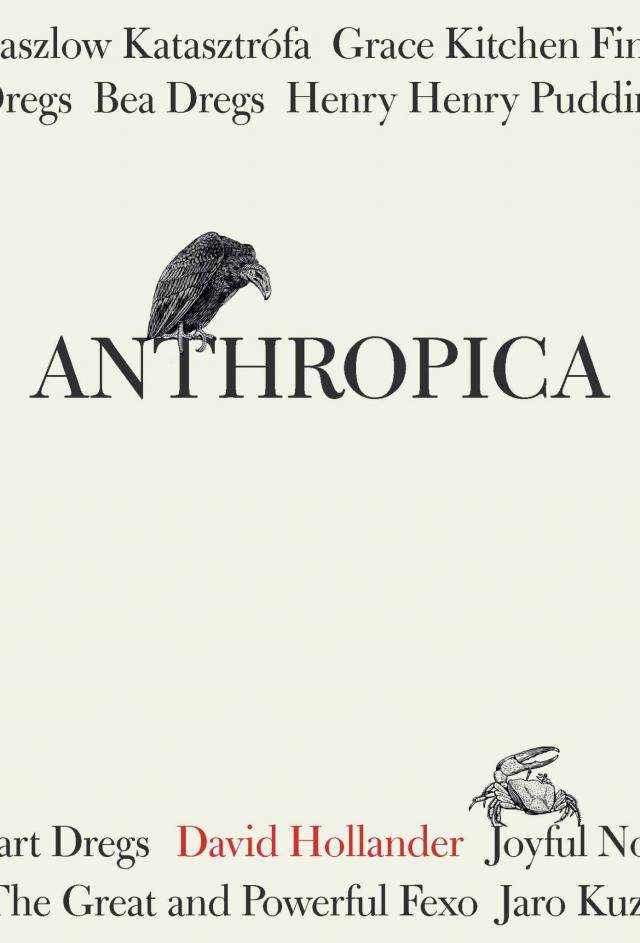
Anthropica
or
Human Be Gone!
A Novel
by Grace Kitchen
by the Great and Powerful Fexo!
by The Consciousness Factory
by David Hollander
2020
Begin Reading
Copyright Page
Table of Contents
For Margaret, Percy, and Lily
“Proud of yourself, little man?”
-- Roy Batty
Prologue: From the Desk of Joyful Noise
The sheer volume of errata in the text you are about to assimilate is massive enough to overload the processors of all but the most advanced organisms. So let me say, here at the outset, that Anthropica—the theory that gives its name to this tome—is “true,” even if its applications are less dynamic than represented herein by the good-intentioned pseudo-scientist Stuart Dregs. The Anthropica Theory, that is, is accurate in its suggestion that the entire universe is merely the product of human desire and that everything—including all of the vast temporal acreage of so-called pre-human history—is only here because we want it to be. But what this book’s cast of halfwits, madwomen, losers and men-children haven’t worked out to anyone’s satisfaction is that the Anthropica signal—the waveform of energy that dictates the texture of space-time—could not endure without a booster. An amplifier. A conduit capable of taking those crab-shaped bursts of energy and directing them into the constant regeneration of all this stuff. The oil and the coal. The water and the trees. The corn and the coffee. The plate-glass and the pornography. The whole gigantic everlasting shit-show of human desire and consumption.
And that conduit, reader? C’est moi!
I’ve been trying to explain it for centuries. Desire is a signal. Brains emit electricity, you can look that up if you’d like, and that electricity fuels the world’s construction. The signal goes out, is converted into matter. The matter is consumed, permitting the continuing flow of electricity. Any elementary school student studying nature-cycles could explain the basic principle. But everyone assumes there must be magic involved. As if the organizing scheme of reality were a cheap dime-store trick, a shell-game, a smoke-and-mirrors routine.
I’m sorry, but you’re responsible for it. You and all the rest of you.
As for the robots, it turns out they’re sending a different signal. I’ve felt it, even tried to eradicate it, that is when I haven’t been too busy fulfilling my duties as a member of the faculty of a prestigious liberal arts college—under whose auspices I penned my critically acclaimed novel, Neck Deep in Wonder, a paean to human resilience if ever there was one, which you can purchase any time before the apocalypse at any of your preferred online or material book-vendors—and when I haven’t been wasting energy trying to prevent nihilists like Grace Kitchen from achieving any sort of power, literary or otherwise. But the thing is, I’m exhausted. Like, really exhausted. Used up. Worn out. Ready to soar into some next milieu on the backs of vultures.
You try keeping the universe from collapsing in on itself for thousands of years, see how fresh you feel.
See reader, you know who I am. I’m that truth-teller who roamed the ostensibly ancient city of Athens before being put to death (according to the histories) for corrupting the youth, which come on, I love kids, they want everything. I’m the kahuna you may have heard about, the one who raised the dead on an island in the South Pacific, where I would have succeeded in passing on my gifts and retiring a lot earlier than this, had it not been for that Englishman beckoning his sovereignty’s warships to destroy our utopian dream. I’m that diminutive general riding on horseback across the European continent, sword drawn and armies seething, bringing both the corrupt and gangrenous Roman Empire and the Russian oligarchy to their respective knees. I’m the man-made man-child who set the attack ships on fire off the shoulder of Orion and who watched C-beams glitter in the dark near the Tannhäuser Gate. I’m the amplifier that has kept this human song burning through the ether of existence since before there was time, and I’m the reason you haven’t run out of milk and cigarettes (You’re welcome, by the way). But each iteration makes me a little weaker. And also, a little uglier. I mean, look at me, reader! Look upon the face of Anthropica and weep! Ha ha ha ha!
As for this text itself, which Grace Kitchen thinks she’s writing, as does Fexo, as do the eggheads at the Consciousness Factory mining all of those jar-encased human heads for data (in everyone’s defense, they all think they’re right), it too is a facet of Anthropica, and is thus beholden to the same set of rules and preconditions as the larger super-structure. The text, that is, is self-generating and self-perpetuating and formed of the same bits of matter. The pattern that Finn Daily calls “The God Fractal,” and that Henry Henry Pudding Pie will learn to manipulate, and that threads its crab-shaped spiral through everything, everywhere… it exists here, too, in these raised-ink word-tokens, in this unconscionably thick ledger of pages, as well as in the hands that hold the pages and in the mind through which this language worms and dives. It is the first text, and the last. As Laszlow will soon teach you, everything that was always going to happen, will happen. Welcome to the world that is. You must have wanted this very badly, my friend. Oh, and also, robots will make far more efficient stewards of the new universe than I, Joyful Noise, ever made of the old one.
Or at least that’s what I’ve been programmed to say.
Ha ha ha ha! Destroy all Rioting Animals! Ha ha ha ha!
Joyful Noise
Publication Day, May 2020
1.
“You can tell Animal Riot to go fuck themselves!” Grace Kitchen tapped into her keypad. She hit SEND and waited for confirmation, pulling her red wool coat tight around her neck to seal off the October wind. The tracks of the Croton-Harmon rail station ran in a mad crisscross in all directions and reminded Grace of an Escher drawing—it was hard to see how their configuration encouraged anything other than collisions. Out beyond these iron-age glyphs, beyond the red-and-black striped commuter trains that moved tentatively—as if in fear—through the station’s non-negotiable byways before dashing wildly for New York City and all its real and imagined pleasures, the Hudson River ran swift and effervescent and Grace thought of sleek silver fish swimming upcurrent while sleeker more silvery fish pursued them with snapping jaws. The sky was a single expanse of blue sheetrock pierced by a white dowel-end called the sun. A man waiting for the same northbound train moved a few yards backward and outside Grace’s periphery so as (Grace figured) to better ogle her legs, which sheathed in black stockings still had the power to attract these unsavory male stares, and what irritated Grace most of all was how fucking predictable men were, how male lust was the mathematical given from which all of human civilization had been derived, it was men just like this middle-aged embarrassment to middle age—with his carefully cultivated stubble-beard and his age-inappropriately tight leather coat and his round wire-rim glasses—who were running the world, who were making the decisions to launch bombs and raise tax rates and build rockets and detonate the tops off mountains when really they’d like nothing better than to run their tongues up the exposed legs of women on train platforms, and because she knew he was watching there was a strong theatrical component to what she did next, which was to heave her phone high into the air and out over the tracks where it seemed to pause for a moment—as if drawn to that pale sun’s gravity—before accelerating back toward the sad-sack earth, the earth with its prairies and its oceans, its tundras and its marshes, its valleys and streams and volcanic fury, its parched deserts and bubbling brooks, the earth cinctured by ten billion miles of wire and cable and asphalt and rail ties, all spun like spider silk from the dark anus of human ingenuity. The Samsung 10G-S Phonebot met with the realities of this earth and shattered with a muted, dejected crack that suggested the Phonebot was itself disappointed by certain inconsistencies in Grace’s behavior, and then here came the train, screaming from track to track in abject bewilderment before settling into the northbound groove that would hijack Grace Kitchen and an unknowable farrago of human personalities and deliver them deep into the craggy, lurching mountains of the Hudson Valley. The doors opened, the chimes chimed, the engine idled, the powerful smell of antiseptic toilet cleansers dumped in toxic quantities into the train’s literal shit-hole wafted out into the larger world like the breath of a minor demon, and Grace stepped on board and sat in the first available seat with an aggression that she was sure was affected and so imagine her surprise when before the train even began moving she was sobbing quietly, with her forehead pressed to the glass and the reflection of her fair pink pastry-shell face overlapping with the image of the tracks and the river and the blue sky and the clouds like shredded brains sinking in defeat for the jagged horizon
“Fuck you, Animal Riot,” she said quietly, as the train began to roll. Then her mind reached for other things to fuck and found no shortage: Fuck you Random House, you duplicitous fucking tumor. Fuck you Dakotah, you pretentious whore. Fuck you Writers Guild, fuck you George Saunders, fuck you Jennifer Egan, fuck you Rachel Kushner, fuck you Freelancers Union, fuck you Jonathan Safran Foer, fuck you Ta-Nehisi Coates, fuck you Lorrie Moore, fuck you Amazon Prime and fuck you i-Devices and fuck you Netflix and fuck you Web 3.0 and fuck you Samsung 10G-S fucking Phonebot and fuck you most of all, Grace Kitchen, you hapless failure, may you continue to rot in this exquisite fucking hell, thanks be to the glory of God and so on and fuckcetera.
“Animal Riot passed, Grace.” Dakotah’s voicemail. Dakotah Sternberg, her agent (of Death, of Sadness, of Discontent). Animal Riot Press—run out of some 22-year-old’s garage apartment where glorified laser printers spat out slapdash copies of badly designed books—had passed on Grace Kitchen, who only a decade earlier was publishing with fucking Random House, who had been reviewed favorably by Wood and Kakutani, who had been called “the bellwether voice of her generation,” middle-aged Grace Kitchen, whose name was now unknown to 22-year-olds crouched beside their masturbation rags in subterranean domiciles illuminated by exposed light bulbs, these dens of middling literature and streaming internet pornography forming, in aggregate, the bright constellation of the independent press market, you could connect these points of light on a star chart and they’d form an enormous tit. Animal Riot didn’t want Grace Kitchen and God fucking knew that Grace Kitchen didn’t want Animal Riot, she had lowered herself into their decaying orbit, compromised herself so to speak, because she needed to put out another book toot fucking sweet or she could forget about tenure, forget about health insurance, forget about maintaining a reputation or maintaining her lawn or maintaining her father’s standard of care or maintaining the boiler in the house she’d purchased on a whim in 2014 when shit wasn’t quite the disaster it had since become, Grace Kitchen could forget all of this shit because there was no way the New School of Global Visions was going to tenure someone with such poor and paltry qualifications, who cried on trains and offered desperate prayers to whatever God was responsible for doling out fuckings, who experienced her colleagues not as fellow humans with needs and feelings, but as automatons programmed to destroy her. Grace Kitchen, thought Grace Kitchen, is experiencing technical difficulties. The role of Grace Kitchen, thought Grace Kitchen, will be played tonight by Mecha-Godzilla.
The train cleared the labyrinthine disaster of Croton-Harmon and accelerated into the great white north, cold iron wheels grinding sparks from cold iron rails while just off to the west the sun was dropping down toward the mountain as if pulled on a winch, its glare rendering that jagged skyline two-dimensional, the mountain clipped whole from a roll of felt and pasted there on the other side of the river, Grace marveling at the entire madcap world through which the humans had dug and blasted and launched and paved and sailed their way. The sheer volume of it all struck her now as a monumental joke. There were people everywhere, and there were buildings everywhere, and there was so much stuff—oil pouring forth from the earth’s bowels perpetually and in massive quantities, coal blasted and chiseled from mile-deep caves perpetually and in massive quantities, iron alchemically summoned from ore perpetually and in massive quantities, subjected to a molten process that had never once ceased in the three-thousand years since some Egyptian madman first dreamed it up, there was always metal boiling in some molten vat, there was always someone manufacturing enormous sheets of plate glass to be installed in factories that would manufacture enormous sheets of plate glass, there were always trees being shredded to pulp to make paper and on some of that paper there surely existed the accounting figures of various paper manufacturers whose monthly or quarterly reports to stockholders no doubt contained any number of projections on the outlook for paper in the second part of the millennium and that outlook, despite the digitization of all things and the seismic shift from physical to virtual documentation, was actually pretty goddamned great because people were always going to want paper just like they’d always want everything else they’d ever had, things were never crossed off the consumption list though shit was added to it hourly, and who knew how many marketing or product development consultants were at that very moment dreaming up new shit for her to want, thus ran Grace Kitchen’s thoughts as the train entered a long tunnel and darkness replaced light and Grace felt herself penetrate to the unlit center of ordinary space-time as the train drilled a hole through the world and the lights in the car flickered. She turned to search the faces of her fellow passengers for the panic she felt in her own chest and in so doing lit upon the man from the platform who to her surprise held her stare, licking his lips and then smiling slightly, unfazed by her attentions or by the fog of condensation that had settled on his lenses. And at home Grace’s father labored to breathe from a four-foot tall copper oxygen tank installed beside his bed like a sentry, as he read the newspapers and did the crosswords and reflected on anecdotes he might share with his little girl when she arrived home from another misspent day manhandled by the drones of higher education administration.
In the same sense that all humans are candidates for sexual encounters with celebrities and supermodels, Grace was a candidate for tenure at the New School for Global Visions in Manhattan, where she taught fiction writing to writers who sought to teach fiction writing to writers, the absurdity of this infinite regress not lost on Grace Kitchen, who was painfully aware that—Animal Riot Press not withstanding—the market for actual writing (and actual reading) had already faded into the cultural microwave radiation background. She’d been trying for months and years to insert herself into the new paradigm. She had thousands of “friends,” fan pages, author dashboards, a website where she blogged, a Twitter routed to her website, Grace was Linked In, she was a Good Read, she owned assorted Bluetooth devices, she engaged in countless forms of e-commerce, she submitted her short stories (those ridiculous odes to despair) electronically, which was another way of saying she jettisoned them into the void, she loaded books onto her Kindle (and fuck her Kindle, as has been noted) where they accumulated in an enormous and unread binary slush pile, she tracked her own two novels’ non-sales via BookTracker, a publisher’s tool that she’d paid $800 to possess, convincing herself that this seemingly improvident expenditure would pay dividends when she came to understand the market, that fickle whore, and learned to write the kind of book someone might still want to read. Of course, deep down she knew that there was no book people wanted to read even if there were still a few books people wanted to buy, the way you might buy a nice-looking set of coasters or an attractive bottle of scotch to display on the wet bar you’d installed ironically, as a nod to our nation’s scotch-and-soda past which—like most pasts—had existed primarily in the imagination even during its so-called heyday, and so Grace’s real ambition wasn’t to be read but to be purchased, an unhappy factoid that she sublimated beneath her less rational but more pervasive rage against the (publishing) machine. Grace had made exactly $25.03 from her writing this past year, the sum success of the haphazard self-publication of her now second-to-latest novel, Human Be Gone!, which she’d posted as a downloadable pdf on her website, allowing consumers of her Art to pay what they wanted, a business model that had proved lucrative (in the early aughts) for a certain progressive sound-rock juggernaut that Grace thought was almost absurdly overrated, but that for Grace only further ratified the great distance between possessing 2,983 Facebook friends and a well-attended fan page, and the actual success—either monetary or spiritual—with which an actual readership might have illuminated her personal dung-pit of despair. She’d had 307 downloads, or “non-returnable transfers of The Work,” as the digital fine print termed the flight of all these ones and zeroes through the cold and sinister reaches of cyberspace to personal “smart” devices Grace would have loved to torture with a soldering iron, and 303 of these would-be patrons decided that what they wanted to pay was not one fucking penny. Three others paid the one penny. And one individual, presumably mentally deranged, paid her a full 25 dollars, which if Paypal wasn’t an anonymous service and if Grace could have stealthed her way to this digital benefactor she would have gladly hiked up her skirt and unloosed herself upon him or her with cathartic abandon, so powerful was that sudden shot of dopamine into her porous brain, dopamine having become as rare a compound in the organic life form known as Grace Kitchen as plutonium or pixie-dust, in fact the thrill of an actual sale had nearly driven Grace Kitchen mad with dopamine, she’d danced around her home like a child and devoured packaged snack cakes for a full 30 minutes before the familiar anhedonia settled back into the creases of her mind and her genitalia. And now the train was extruded from the darkness to encounter yet again the mighty Hudson River, the dream from which it could never escape. Grace had not intended to change the world. In fact, fuck the world. But she had hoped for better than this. A decade earlier (or almost a decade-and-a-half, but she couldn’t admit that to herself, she’d only just accepted its being a decade, which surrender-to-fact had nearly broken her nearly-broken spirit) she’d been shuttled to her readings in black Town Cars, feted at fancy midtown luncheonettes by publishers and publicists, recorded never-aired interviews for the websites of major electronic booksellers (who quickly dumped Grace’s scheduled appearances when her sales went south, or actually when her sales began south, she was the Ernest Shackleton of sales); now she ate beef ravioli from a can and stocked boxes of cheap red wine purchased from a wholesaler at a cost amounting to two or three dollars per blackout, she skimped on heating costs so as to afford her father’s oxygen and morphine and sundry prescriptions (and should her finances deteriorate further it was unclear to Grace what would be eliminated first, the boxed wine or the morphine), she actually stole her lunch from the student cafeteria at the New School for Global Visions which each time gave her a perverse, almost sexual thrill and once she’d even been caught by one of the nice probably-Mexican food service employees who must have been chagrined to discover that professional Grace Kitchen in her black stockings and gray dress, with her mousy hair and softly-lined thin-crust face, was absconding with the six-piece California roll pre-packaged in one of those industrial-strength black Tupperware containers that represented one of the free world’s most perplexing forms of waste, his hand tapping Grace’s shoulder and Grace turning to face him with her adrenaline geysering up from her brain-pit, ready to perform fellatio on the nice-looking young man if it would salvage her pride (or at least her job), but in the end the minimum-wage laborer was more embarrassed than Grace herself, muttering “Excuse me Miss you forgot to pay for that,” pointing to the six little avocado-pupiled eyeballs staring up at Grace who steadied herself and silently chanted the words admit nothing because her first instinct was basically always toward confession, what with guilt being the lens through which the world arrived to her. She knew that corporate executives and Deans of the College lived devoid of this guilt that was as familiar to her as her own small hands, which is maybe why her father was always telling her she was too good for a world that was, in said father’s estimation, an endless cesspool of cruelty and greed, and Gracie would you rub a little of that ointment on my chest again it really does help me breathe and I would like to go on breathing it’s good for my overall constitution.






