

Him, p.1
HIM, page 1


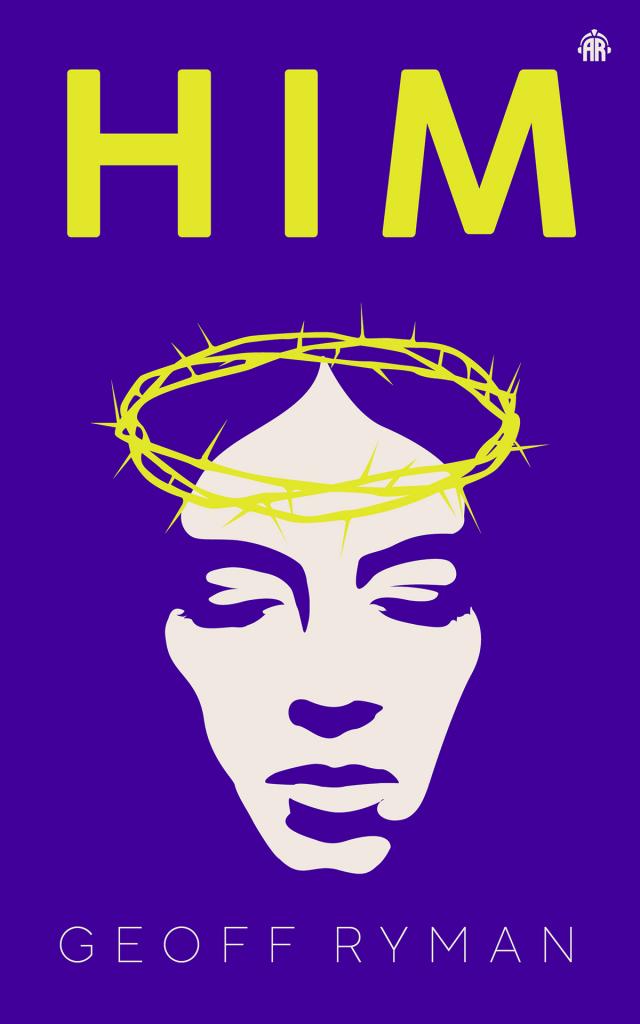
PRAISE FOR GEOFF RYMAN
“Geoff Ryman has long been one of our finest writers, with no two books the same (or even similar). With Him, Ryman rewrites the Greatest Story Ever Told, using all the tools he has developed from his fantasy, science fiction, and historical fiction to craft something new from material so familiar, giving an immediacy and a reality and a shocking sense that we have never encountered this story before, nor this prophet nor his teaching. It’s the kind of novel that will win awards and reach hearts and minds and be burnt on bonfires too. A profoundly religious book, in such unexpected ways.”
Neil Gaiman
“Him feels like the real story at last. Ryman’s uncanny ability to get inside people makes this one of the greatest versions of the old story. The family drama, Yeshua’s parents and siblings—all the key moments seen as if by lightening—it comes alive in a supremely vivid way. This time for real. It’s unforgettable.”
Kim Stanley Robinson, award winning author of The Mars Trilogy
“Ryman offers an exceptional journey into the heart of human experience with this profoundly affecting story. Beautifully imagined. It has a transformative, compassionate power. I loved it.”
Justina Robson, award nominated author of Silver Screen
“Ryman challenges his readers as he always has, with an enormous, defiant, heart. Him is exhilarating and liberating to believer and non-believer alike.”
Paul Cornell, author and screenwriter
“Here is the Son of God you never knew. Him is shocking, moving, profound and reverent. Only Geoff Ryman could have written this book. It is a masterpiece.”
Michael Swanwick, Nebula award-winning author of Stations of the Tide
“Potentially blasphemous, definitely thought-provoking. Ryman asks a simple question and supplies a complex, multifaceted answer that stays with you long after you finish reading.”
Antony Johnston, creator of Atomic Blonde
ANGRY ROBOT
An imprint of Watkins Media Ltd
Unit 11, Shepperton House
89-93 Shepperton Road
London N1 3DF
UK
angryrobotbooks.com
twitter.com/angryrobotbooks
A Virgin Birth Can Only Mean One Thing
An Angry Robot paperback original, 2023
Copyright © Geoff Ryman, 2023
Cover by Francesca Corsini
Edited by Simon Spanton Walker and Andrew Hook
Set in Meridien
All rights reserved. Geoff Ryman asserts the moral right to be identified as the author of this work. A catalogue record for this book is available from the British Library.
This novel is entirely a work of fiction. Names, characters, places, and incidents are the products of the author’s imagination or are used fictitiously. Any resemblance to actual events, locales, organizations or persons, living or dead, is entirely coincidental.
Sales of this book without a front cover may be unauthorized. If this book is coverless, it may have been reported to the publisher as “unsold and destroyed” and neither the author nor the publisher may have received payment for it.
Angry Robot and the Angry Robot icon are registered trademarks of Watkins Media Ltd.
ISBN 978 1 91520 267 3
Ebook ISBN 978 1 91520 275 8
Printed and bound in the United Kingdom by TJ Books Limited
9 8 7 6 5 4 3 2 1
d_r0
“History is what a living society makes of the past.”
Andrea M Berlin
CONTENTS
PART 1: HOME
Chapter 1
Chapter 2
Chapter 3
Chapter 4
Chapter 5
Chapter 6
Chapter 7
Chapter 8
Chapter 9
Chapter 10
Chapter 11
Chapter 12
Chapter 13
Chapter 14
Chapter 15
Chapter 16
PART 2: HIM
Chapter 17
Chapter 18
Chapter 19
Chapter 20
Chapter 21
Chapter 22
Chapter 23
Chapter 24
Chapter 25
Chapter 26
Chapter 27
Chapter 28
Chapter 29
PART 1
HOME
CHAPTER 1
MOTHER
Maryam laboured up the Mount of Olives, wondering how this morning could be so like any other.
From over the walls that lined the road came the sound of mothers calling and children squealing. A gateway groaned open and a woman in an apron threw dirty water onto the street. The servant apologized and was startled when Maryam snarled, “Pour blood on me!”
A human beast of burden struggled down the hill, holding back a cart full of firewood. A sweat-stained rag was wrapped around his head; his face was creased down the middle of his cheeks. His eyes caught hers as he passed: you think I endure? Despair in those grey eyes, as if he knew who she was and what had happened. Despair that his own life would only be work, pain, and early death.
Over the flat roofs, the Temple rose like a snowy mountain in sunset, marble and gold. Looking so proud – but it couldn’t stop the Romans. What it had was beauty, and what use was beauty? What use was any of it?
The gate to the house hung open so she slipped in sideways. Their host was waiting in the shade and jumped forward as soon as he saw her.
“What has happened, what has happened?” he demanded.
Maryam felt like a seed popped from an apple, tiny and hard. “Where’s the babe?”
The old uncle said, “I didn’t wake her. What’s going to happen?”
Maryam looked at his anxious, kindly face and found that all of her sympathy had been burned through. “They’re going to kill him,” she said, and went round the side of the house to mount the steps to the upper floor.
The child Rutit was not asleep but lazed under a blanket, singing to herself. Maryam leant over her and kissed her and said, “Come, Baby, we’re going back to be with your mother.”
Maryam took the child’s blanket, found her tiny sandals, and bundled her up. The uncle was leaning against the doorpost.
“What’s this?”
“Don’t make me say it,” she said.
The host was outraged. “They can’t be that stupid. What did the Kohen Gadol do? He’s supposed to defend us. Will they stone him?”
Maryam couldn’t remember the fancy Greek word. “Some horrible Roman thing.”
She pushed past him, but the household had lined the steps and crowded the courtyard. She would have to squeeze past them on the open staircase near the edge. They shouted questions. You left him alone, cowards, why should you know anything?
The householder told them, “They’re executing him.”
The useless cries of dismay or shock. Maryam looked at their faces, round-eyed and undone. They had expected exile, at worst prison. But this? This was without precedent, bad beyond imagining.
She began to walk down the outside of the steps, turning the infant away from the edge.
Someone took her arm and shouted, “Make way! She has a child with her.”
Down the steps, across the crammed courtyard, each person touched her or bowed or said, “Mother we are so sorry.” Or “Mother be at peace.” She realized someone had knelt to kiss her feet. “Pray for us, Mother.”
Tears came. “Pray for him!”
CHAPTER 2
THE LIONS OF EDEN
Years before, Yoazar barBeothus rose from cushions and gestured for his niece to sit.
Maryam was still standing, uncertain of how to accomplish that. She was used to dining couches, not cushions on a courtyard pavement.
Yoazar began to roll up his scroll. Maryam plonked herself down like a mattress. Her dress – it looked like Yoazar’s tablecloth, all red and blue stripes with tassels. She liked to dress, poor thing.
Yoazar forgot himself in appraisal of his niece. From the front, the girl could be beautiful – those glittering eyes, the long front teeth that made her smile bright and distinctive. From the side she looked like a pigeon – plump cheeks and a beak.
“Uncle.” She hauled in a breath, and her smile faltered. “Rabuli. I have some news.”
Had she found a husband? Yoazar moved the mountains of his face into something like a smile. “I pray it is good news, Maryam.”
“Yes. I suppose.” Her eyes flickered downward then back up. “I am with child.”
Yoazar sagged inwardly. Oh God. Poor stupid girl – all that learning, see what it does for you? Ah well, it is God’s way.
Her hands twisted the tassels of her tablecloth dress. Maybe she had indeed made it herself from a tablecloth – her father was dead and the family was not prosperous.
Hesitant – normally his niece was too confident. “The…the pregnancy came about in an unusual way.”
There is only one way of getting pregnant, and there’s nothing unusual about it. A handsome young scribe? Her cousin? Sex with another woman who’d just had sex with her husband? In his years in the courts, Yoazar had heard all of that, and more. He indicated she should help herself to figs and bread. “Unusual how, cousin?” He hoped his voice was sympathetic.
“Well. I didn’t do anything.” Her hands, her cheeks, all quivering.
What did that mean? Yoazar reached for her hand, but stopped before taking it. “You were forced?”
She shook he r head, but she was smiling, almost swollen with joy, her eyes closed as if in prayer.
Then she told him. Angels, annunciations.
Yoazar’s hand jerked back. First her cousin Elisheba with her miracle birth and now this. A fashion for religious mania.
Women who are unfulfilled, they flap like doves without realizing it. A friend of his mother’s would sit in the market, legs apart, skirts hoisted high. A poor pigeon seller finally did what any man would do. Yoazar had helped the simple fellow escape the usual punishment. It was so unfair, given the provocation.
“No point then asking who is the father.” Yoazar realized that he’d said that out loud – but perhaps it was just as well. “Can you find a man to support you?”
She looked surprised, then smiled. “It could be that God will protect me.”
Sometimes women only thought they were pregnant. Poor Maryam. The glittery eyes.
Yoazar rumbled. “Well. There will always be a place for you to live here. What has your mother said?”
She looked downcast then. “I haven’t told her yet. I was hoping you would explain to her the wonderful thing that’s happened.”
Yoazar had worked his way up the priestly hierarchy by taking on difficult instances and helping. (A donation from his supporters to Herod the Great had not gone amiss either). He was shocked by nothing. Human folly, anger, weakness, all of these made him sad and slow, but never angry. He’d long ago realized that God rarely granted miracles to individual people. Religious authority had to be used sparingly. “Maryam. I will do everything I can.”
Her hand was on her belly and her face was cocked to one side. “I felt it. There was a strange sensation – a kind of cramp and a warmth. I could tell something – unusual? – had happened. To be honest, I thought it was sickness.”
Perhaps it is. Women get growths and die. Yoazar found he had nothing further to say. His servant girl flapped out of the kitchen with some mint water. This time of year, after the rains, delicious spring water trickled through the Kohen Gadol’s fountain.
The Kohen Gadol and his niece talked for a while about Maryam’s mother Avigayil; about how after all these years she still mourned her Damascene husband.
“If you or your mother ever need anything,” Yoazar began.
Maryam held up a hand against the offer. She’s tough, Yoazar thought, and that comes neither from her father nor her mother.
Finally the priest apologized but he had work to do. “Peace be to you, Maryam.”
The overdressed, haughty little thing marched out of his house bunched like a fist. She knows I won’t tell her mother about the angel. She knows what I think of her.
Yoazar’s wife Tara stood waiting, half hidden behind the pillars. He saw his wife’s anxious face and flicked her forward with a wave of his hand. “So she’s told you this nonsense as well.”
Tara nodded once, hugging herself; she was the twin of Maryam’s mother. “She believes it.”
They were members of the Kohanim. There was no question of someone in the family or their class being held up to public shame.
Tara sighed. “She really is the most moral woman.”
“She’s mad. I don’t suppose you know of any man mad enough to marry her?”
Something about his wife’s bunched cheeks. Ah. The seriousness, the shaking, the sideways approach.
“There’s Yosef,” she said.
My goodness. The cleverness of women. Yoazar blurted out a laugh. “He’s crazy enough.”
Tara seemed to melt with relief. She laughed too. “He’ll believe her.”
They both laughed. Yoazar loved his wife.
Yosef had gone about proclaiming that Adam and Hawa were not a man and a woman.
Plainly a man could not give birth to Hawa as Adam did (so Yosef said). Hawa was called helper, companion, servant, even soldier – “ezer” – the male form of the word, and thus neutral of course. But for a woman?
Yosef had said in public in the Place of Gentiles, (and here Yoazar had felt faint and faltered) that Adam had not been a man and Hawa had not been a woman.
Yosef was like an ever-blooming flower of foolishness. He was a Levite, with a role to play in the temple, but he had no authority. He had said in public, declaiming not one hundred steps from the Beth Yahu, that Adam and Hawa had the sex – or sexlessness – of angels. They were neither or both, and since they were immortal, plainly they had no need to reproduce.
The audience were devout people waiting to enter the Court of Women. Yoazar had heard them growl, so forced himself to laugh and airily say, “Oh, Yosef, that is so clever, you keep us so amused.”
Yosef held a finger to the sky. “Amusing? Kohen Gadol, for me, it is a catastrophe.” You could see in the man’s swimming eyes that he meant it. “The loss of half our selves is a separation as devastating as Babel.”
In the crowd, smiling grimly was Eyanaphon, Eyanaphon the Sadduci, so young and small, beautiful like a woman, with dark gazelle’s eyes and something eager in his face. He was already leading young fierce men in immaculate white. Yoazar had known then: there will be trouble.
Yosef came back the next day to say the same thing. Eyanaphon was not there, but his party were. And they said, “You talk of such things in public?”
Before Yosef could answer they said, “And how would we have children? You are counselling the end of the Yehudai?” Followed by: “You think God wants his sons to perish from the Earth?”
The term “Son of God” – barYahu in the Common Tongue – simply meant you worshipped the God of Yisrael and to do that (unless you were one of those Shomeronai who worshipped at that mountain) you had to live in Yehud. You had to be near the Temple or at least make pilgrimages to it.
Women, of course, could not be Sons of God.
Yosef looked miffed. “It is not for all. But. If a man were to take a knife to his private parts, he would be moving closer to Godliness.”
Some people laughed. Some shook their heads. Yosef was a Levite; a member of a tribe with complex relations with the priestly clans. He had gone beyond bounds.
One of Yoazar’s innumerable cousins nodded knowingly and muttered to him sideways. “They say he tried to do it to himself. Uh! That unspeakable thing, when he was younger.”
Yoazar loomed over Yosef and said, in a low voice. “You are coming with me now before you get yourself killed.” That was only a slight exaggeration.
A day later, a story started to spread that a boy of thirteen, at that crucial age, inspired by Yosef’s lunacy had done this dreadful thing, emasculated himself. It couldn’t be true. The Kohen Gadol would have been told at once. But people love stories that give them a chance to be outraged.
Yosef was in danger of being stoned. Yoazar had attendants arrest Yosef and hold him in rooms in his own house. Yoazar then went to the Sanhedrin in their circular room at the east end of the Stoa, and asked: can anyone name this thirteen-year-old? Could anyone take Yoazar to him? Yoazar had only recently ascended and was still in a period when everyone wanted him to do well. So they talked to him, and asked questions for him. He visited the most sensible of the families.
No name. No boy. In each house he said, “I am beginning to think this is just a story.”
Yosef barLevi was to be sent into exile.
Dangerous religious radicals were sent in exile out of Yehud, north even beyond Shomeron, to the Galil. The people there were crude, rough, not really Beni Yisrael at all. The land had been forcibly converted to belief in the God of Yisrael by the Hasmonean kings only ninety years before. And the way the Galilai spoke! Blurring consonants and vowels.
There had even been a suggestion that the Galilai be barred from the Temple lest they mispronounce a word in the liturgical tongue and offend God.
God moves through talk.
That’s what the Perisayya said, at least those who lived among the elite of Yerusalam.
Most of them spoke Greek too. The word hairesis simply meant school of thought, not something to be punished. And how many schools of thought flourished: the Perisayya who argued that the spoken word had the value of the written, the Sadducai who ran things, and of course the saintly Essenai who now mostly lived in the wild (who just to add to the richness also called themselves Zadokites, basically the same word as Sadducai).
Yosef was given the freedom of Yoazar’s courtyard.






