

Sito, p.1
Sito, page 1


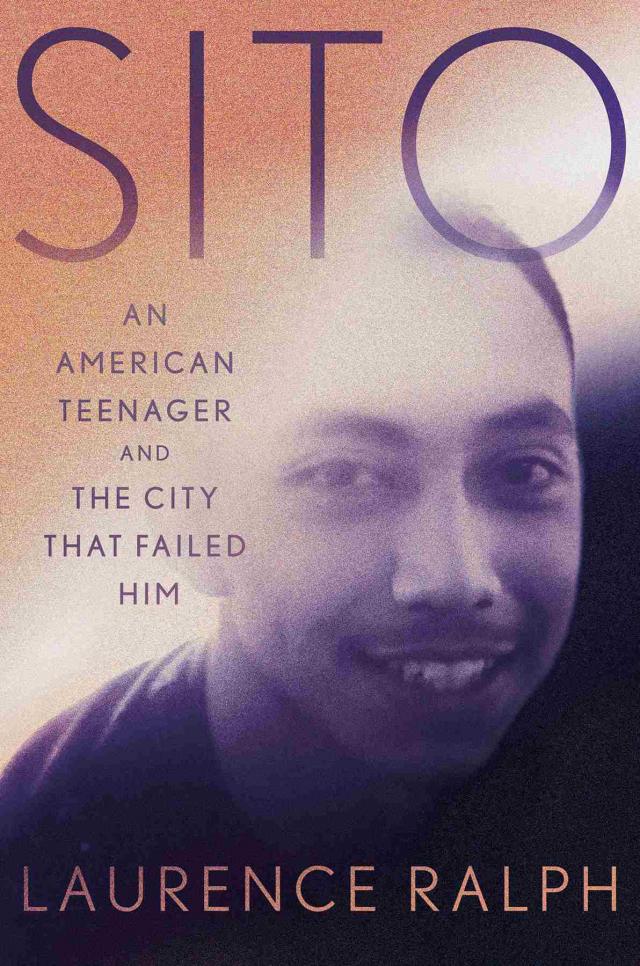
Names and identifying characteristics of some individuals have been changed.
Copyright © 2024 by Laurence Ralph
Cover design by Dana Li
Cover photo taken by Sito’s mother, Beatriz Enciso
Cover copyright © 2024 by Hachette Book Group, Inc.
Hachette Book Group supports the right to free expression and the value of copyright. The purpose of copyright is to encourage writers and artists to produce the creative works that enrich our culture.
The scanning, uploading, and distribution of this book without permission is a theft of the author’s intellectual property. If you would like permission to use material from the book (other than for review purposes), please contact permissions@hbgusa.com. Thank you for your support of the author’s rights.
Grand Central Publishing
Hachette Book Group
1290 Avenue of the Americas, New York, NY 10104
grandcentralpublishing.com
twitter.com/grandcentralpub
First Edition: February 2024
Grand Central Publishing is a division of Hachette Book Group, Inc. The Grand Central Publishing name and logo is a trademark of Hachette Book Group, Inc.
The publisher is not responsible for websites (or their content) that are not owned by the publisher.
The Hachette Speakers Bureau provides a wide range of authors for speaking events. To find out more, go to hachettespeakersbureau.com or email HachetteSpeakers@hbgusa.com.
Grand Central Publishing books may be purchased in bulk for business, educational, or promotional use. For information, please contact your local bookseller or the Hachette Book Group Special Markets Department at special.markets@hbgusa.com.
Library of Congress Cataloging-in-Publication Data
Names: Ralph, Laurence, author.
Title: Sito : an American teenager and the city that failed him / Laurence Ralph.
Description: First edition. | New York, NY : Grand Central Publishing, 2024. | Includes bibliographical references. |
Identifiers: LCCN 2023036571 | ISBN 9781538740323 (hardcover) | ISBN 9781538740347 (ebook)
Subjects: LCSH: Sito, 1999 or 2000-2019. | Juvenile homicide—California—San Francisco. | Mission District (San Francisco, Calif.)—Ethnic relations. | Mission District (San Francisco, Calif.)—Ethnic relations—Political aspects. | Racism in criminal justice administration—California—San Francisco. | Racism in law enforcement—California—San Francisco.
Classification: LCC HV9067.H6 R35 2024 | DDC 364.152/30830979461—dc23/eng/20230803
LC record available at https://lccn.loc.gov/2023036571
ISBNs: 9781538740323 (hardcover); 9781538740347 (ebook)
E3-20231218-JV-NF-ORI
Contents
Cover
Title Page
Copyright
Dedication
Prologue. Sunday in the Mission
PART I Chapter 1. The Next Crisis
Chapter 2. A Fair Shake
Chapter 3. A Deep, Dark Grave
PART II Chapter 4. Cruel Heirlooms
Chapter 5. Smurf
Chapter 6. Fire Station 18
Chapter 7. Behind Enemy Lines
PART III Chapter 8. The Juvenile in Custody
Chapter 9. The Punishment Factory
Chapter 10. The Storm Inside
Chapter 11. Purpose
Chapter 12. Death Anniversary
PART IV Chapter 13. Dance with the Devil
Chapter 14. The Army Street Assassin
Chapter 15. Lying in Wait
Chapter 16. Compassionate Rage
Epilogue. The Dream
Acknowledgments
Discover More
Notes
Annotated Bibliographies
About the Author
For Sito
Explore book giveaways, sneak peeks, deals, and more.
Tap here to learn more.
PROLOGUE
Sunday in the Mission
It was still hot outside when Luis Alberto Quiñonez—whom everyone called Sito—reached Grant Avenue, in San Francisco’s Chinatown, around 6:30 p.m. on Sunday, September 8, 2019. His girlfriend, Arianna, was with her mother, who had been evicted that day: she had paid her rent late one too many times. “If you don’t move out today,” the landlord told her, “your shit will be in the street.”
“Don’t touch her stuff,” she demanded, stepping between the landlord and her mother. “My boyfriend’s coming right now.”
He’d driven an hour from Oakland in his 1998 Nissan Sentra. Once he arrived, Sito began loading his car. After several trips back and forth between Arianna’s mother’s old place and the new one, Sito made his way back to Curtis Street, on the northern outskirts of the Mission District, for the final drop-off. It had been years since Sito spent an entire afternoon there, in the Mission. The sun had already set when he carried the last box through the narrow hallway of Arianna’s mother’s new apartment. Sito found one of the few spots in the living room where he could actually see the hardwood floor.
“Gently, gently,” said Arianna’s mother as he put down his box.
The sofa was still wrapped in plastic and tape, but Sito collapsed on it anyway.
Just then, Arianna emerged from the kitchen with a glass of water and sat on Sito’s lap. She held the cup as he sipped from it. Sito circled his arms around her waist and rested his chin on her shoulder. Exhausted from the move, Arianna, her mother, and Sito sat in silence, listening to cars pass by outside.
“Okay, I’m ready to see my room now,” Sito joked.
Arianna turned and slapped his chest—lightly, affectionately—with the back of her hand. Arianna’s mother looked at the couple with a smile. In that moment she felt her daughter had truly found her first love. Arianna and Sito were both nineteen.
“Let’s all get something to eat,” Arianna’s mother said. “My treat.”
She offered to take them to Bac Lieu, a Vietnamese restaurant on Mission Street that Arianna liked, a thank-you for breaking their backs in difficult circumstances—at a moment’s notice, no less.
They decided that the couple would go to Arianna’s place to change out of their sweaty clothes and then meet her at the restaurant in an hour. Sito opened the front door and held it for his girlfriend. The chilly air of a San Francisco evening whooshed in. “See you soon,” Arianna said to her mother.
Driving down Curtis Street, Sito had just put his blinker on to make a right turn on Brunswick when he saw a light flash on his dashboard. “Oh, fuck!” he said. “I need to get some air.”
Sito was from the Mission; he knew the nearest gas station was an Arco off Naples Street, just a few minutes away.
They drove past the Cordova Market, the corner store with murals of Jerry Rice and Willie Mays on the outside, and then made a right into the Arco, parking next to the air pump.
Sito grabbed a few quarters from the cup holder.
“I love you, babe,” he said, exiting the car.
Arianna had texted her mother for the address of the restaurant, but she hadn’t received a reply by the time Sito got back in the car. “I’m going to call her,” she told him.
Sito tried to exit the Arco while a stream of cars blew by on Geneva Avenue. He made a hard right into heavy traffic, causing Arianna to drop her cell phone underneath the seat.
“Sito! Pull over. I can’t find my phone!”
He made the next right, onto Athens, and pulled over on the street of small houses.
Arianna bent over in her seat, hands searching across the floorboard for her cell. “Found it!”
Meanwhile, a person in a hooded sweatshirt stepped up to the Nissan’s driver’s-side window. In an instant, he raised an automatic pistol to the glass and started firing.
Bright muzzle flashes split the night like lightning. Despite the shattered glass raining down, Arianna could see the shooter’s dark round eyes and rigid brow. Arianna pulled Sito toward her, away from the incoming fire, taking two bullets in her own arm.
By the time the shooter finished, twenty-one cartridges had battered Sito’s Nissan, inside and out. Seventeen of those bullets cut through Sito’s neck, shoulder, and chest, the fusillade ripping his stomach wide open.
It had never occurred to Sito that someone might have followed him that evening and watched him carry a houseplant, a flat-screen TV, and a heavy dresser into Arianna’s mother’s new place. Nor had it occurred to him that someone might have tampered with his car’s tires.
But his killer had been following them for some time, just lying in wait.
PART I
Building Bridges of Solidarity: Breaking Down Barriers. Part of a 117-foot-long mural executed in 1997 by Eric Norberg and Mike Ramos for Homies Organizing the Mission to Empower Youth (HOMEY). Located on 24th and Capp Streets. (Photo by Genesis Manyari)
CHAPTER 1
The Next Crisis
Sito was my stepson’s half brother. We only met once, and I am sure he would not have considered me part of his life. But in death he has become part of mine.
I got to know my wife, Aisha, in the spring of 2015, when we were both professors at Harvard. At the time, I held a joint appointment in the departments of African and African American studies and anthropology; Aisha was a faculty member at the Harvard Divinity School. For our first date, we had breakfast at the Diesel Café, in Davis Square, a couple of blocks from where I lived, in Somerville. We settled into seats at a small wooden table toward the back, where Tufts University students always gathered to play pool at night. Aisha rummaged through her sizable black purse while I waited for the barista to call my name.
“Tofu scramble. Egg sandwich for Laurence,” the barista yelled.
I got up to grab our meal.
When I returned, a tattered copy of Renegade Dreams—a book I wrote about the consequences of gang violence—lay on the table. As I put the tray down and sat in front of Aisha, the book flapped open to a dog-eared page. I glimpsed a familiar name: Derrion Albert.
Derrion Albert was a sixteen-year-old high school student from Chicago who was killed in a violent attack in 2009. The melee that resulted in Derrion’s tragic death involved dozens of students, but the state’s attorney ultimately held four teenagers accountable for the crime.
The attack was caught on video; it’s hard to watch. One of the teenagers strikes Derrion in the head from behind with a railroad tie; the others proceed to punch and kick him repeatedly, even after he falls to the ground and lies there motionless. Predictably, the teenage boys responsible for killing Derrion were identified as gang members, though it remains unclear whether they actually were. Those same teenagers were then labeled by the news media as “savages.” Derrion was described as an “honor roll student.”
In my book, I critique the coverage of this juvenile murder case and, by extension, what is usually called “gang-related” violence. The notion that there is an innate difference between Derrion and his assailants, I argue, hinders our ability to understand urban violence. We must come to terms with the fact that youth of color are both highly susceptible to experiencing violence and therefore extremely likely to enact it. When we do not acknowledge this, we fail to understand why some of them gravitate toward gangs and commit violent acts in the first place.
Aisha didn’t refer to the Derrion Albert case in particular. She just said, “Had to read it. Before… you know…”
“We could date?” I asked.
Aisha nodded sheepishly, holding back a smile. “If I didn’t respect your mind, that would’ve been a deal-breaker,” she said.
“Sooooo…” I waited for the verdict.
Aisha grabbed my hand from across the table. “It made me like you even more,” she said.
I felt the same way. I didn’t tell her this at the time, but days before, I had read several of her articles.
Aisha’s scholarship was about a group of religions originating in Yorùbáland, West Africa. The Yorùbá believed in divinities, or angels, called orishas. God created them and sent them to assist humankind’s spiritual and physical evolution. Through sacrifices, offerings, and divination, Yorùbáns communed with their ancestors and the orishas. This kind of spiritual exchange had been a way of life, structuring the societal order, until the transatlantic slave trade began and Arabs and Europeans decimated the Yorùbá Nation.
Many of those enslaved came from elite classes of soldiers and warrior priests. As a result, the New World became inundated with people knowledgeable about Yorùbá religious practices. Enslaved Yorùbáns formed several religious sects within the European colonies: Candomblé, in Brazil; Vodun, in Haiti; and Sango Baptiste, in Trinidad. The variant of Yorùbá religion in Cuba, where Aisha did her research, was referred to as Santería, or Regla de Ocha.
Her book describes the ways in which many people today are openly embracing their various ancestral religions. Aisha herself comes from a family of Santería priests. But I didn’t know much about her faith on our first date. I didn’t even think to ask about it. I selfishly focused on how she felt about me and my work.
That morning at the Diesel Café, I smiled at her from across the table and then paused. I couldn’t help myself. “What exactly did you like about my book?”
“It reminded me of someone,” she said, before explaining that her elder son, Neto, had a half brother. “Sito’s fourteen—the same age as my younger son, Pilli.” Sito is short for Luisito—“little Luis.”
Aisha met Sito and Neto’s father—her ex-partner Rene—when she was thirteen. At the time, a group of girls she thought were her friends had attacked her, pounding her with their fists and kicking her on the ground. A beating like this is a common way to initiate someone into a gang. Young Aisha was faced with a choice: join them or be assaulted every day. Unsure of what to do, she sought out advice. Aisha needed to speak to someone who was respected, someone whom the gang would listen to. A sixteen-year-old neighborhood teenager, Rene, agreed to protect her. He talked to the gang leader, thus ensuring that Aisha was “off-limits.”
Until then, Aisha only knew Rene as one of the boys who hung out on 24th and San Bruno with her friend Lalo. But when Rene came to her rescue, he became her lifeline. Aisha had been homeless when she was attacked. Several months earlier, only twelve years old, she had come home from school to see all her belongings outside on the curb. She and her mother had been evicted. At the time, Aisha didn’t know her mother was addicted to drugs. She only knew her mother was nowhere to be found.
She had been spending her nights sleeping over at her friends’ parents’ apartments. After learning this, Rene’s family took Aisha in. Several months later, she got pregnant. “Everyone told me I was making a huge mistake,” Aisha said. “Back then, being a teenage mom? People assumed my life was over. But they didn’t know…” She paused. “That pregnancy? Having Neto? It put me where I am now. He saved my life.”
With newfound determination, Aisha excelled at Real Alternatives Program (RAP) High School, in the Mission. RAP offered an Aztec dance class as a form of physical education. Participating in the dance class allowed her to travel outside the Bay Area for the first time. She performed in Mexico with baby Neto in tow. Shortly thereafter, she graduated and enrolled at San Francisco State. By then, Aisha realized that Rene’s gang-driven lifestyle put her and Neto at risk. Before the first semester had finished, she left him for good.
Two years later, both Aisha and Rene found new relationships. Aisha married Kalto, and her second child, Pilli, was born. Meanwhile, Rene met Beatriz, and they had Sito.
Despite the fact that they had both moved on, Aisha’s and Rene’s devotion to Neto and their shared history of survival meant that they remained part of each other’s lives as committed co-parents.
Back when Aisha and her sons lived in San Jose, California, Sito visited often.
Aisha described him as a “sweet boy,” the only one of the children who volunteered to help her cook.
“He was a chubby little kid,” she said as she unwrapped the foil from her egg sandwich and took a bite. “And oh, did he love his superheroes. He always wore his Spider-Man outfit.”
Then Aisha’s face turned dark. She chewed slowly before saying that Sito had been accused of a terrible crime. Like the people involved in the cases in my book, he was portrayed in the media as a ruthless gang member. And she prayed the coverage wouldn’t affect his case.
Her eyes started to well up. “If something were to happen to him… it would… it would… just devastate Neto.”
She told me that Neto had struggled with mental health issues since moving to Cambridge at fifteen years old. He’d been diagnosed with oppositional defiant disorder, and getting him to take the drugs the doctor prescribed was a constant battle.
One day Aisha had found a whole bottle’s worth of Neto’s pills floating in the toilet, waiting for her, intentionally unflushed. She thought he was trying to send her the message that she couldn’t control him—that nobody could. Later that day, the principal called Neto to his office. A rumor had reached the administration that he was in possession of stolen cell phones.
After almost three years of motions and delays, Neto’s robbery case was finally resolved. Ultimately, a Middlesex County judge gave him probation instead of juvenile hall. But only a month after the verdict, Neto threw a house party. At the time, Neto, then eighteen, had decided he could no longer take his mother’s rules. So he moved out. His new neighbors called the police after seeing teenagers stream into Neto’s apartment. When the police arrived, he greeted them at the door and promised to end the party. That’s when the officers smelled the pungent aroma of weed.






