R a w hitman, p.1
R.A.W. Hitman, page 1
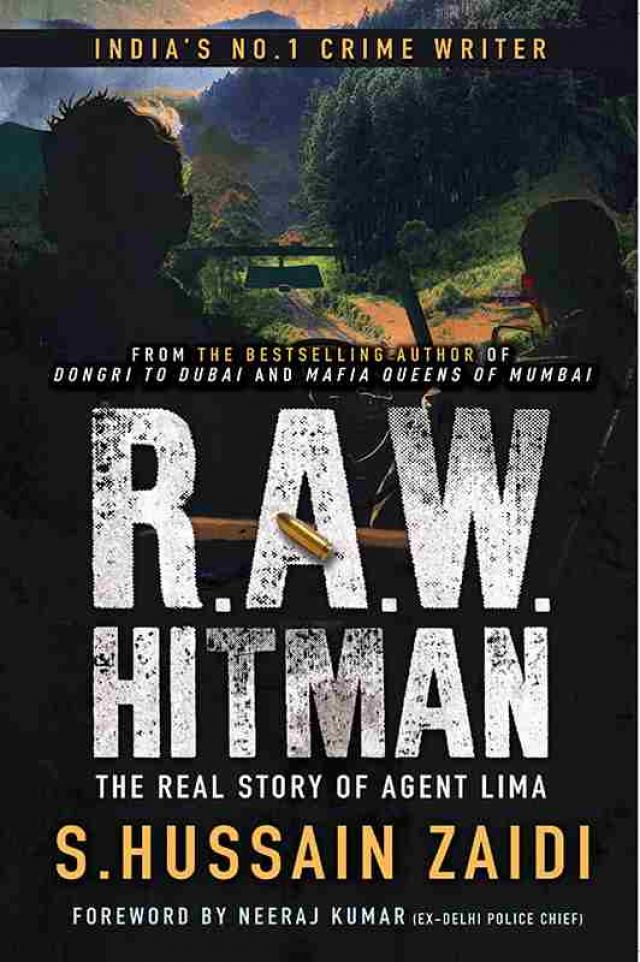


R.A.W. Hitman
S. Hussain Zaidi is a veteran investigative, crime and terror reporter with a career spanning decades. His previous books include Mafia Queens of Mumbai, Dongri to Dubai, Byculla to Bangkok, Mumbai Avengers and Eleventh Hour, some of which have been adapted into popular Bollywood films. Hussain Zaidi lives with his family in Mumbai.
R.A.W. Hitman
The Real Story of Agent Lima
S. HUSSAIN ZAIDI
For
Dr Shabeeb Rizvi,
My Friend and Mentor
Foreword
S. Hussain Zaidi towers over the world of true crime writing in India. He is widely recognized for his seminal works on the Mumbai underworld and is considered a moving encyclopedia on the commercial capital’s mafia. His books Dongri to Dubai, Byculla to Bangkok, My Name is Abu Salem, etc. are reference books on the Mumbai underworld and are grist for the Bollywood mill. He is equally drawn to the genre of espionage and spy thrillers. Mumbai Avengers written by him has been adapted into a popular Hindi movie called Phantom. He has written the screenplay for the web series London Confidential, a spy thriller, currently showing on Zee5. It is, therefore, not surprising that the story of commando Lakshman Bisht, who claims to have been a hitman for one of India’s secret service agencies, has drawn his attention and interest. This book, R.A.W. Hitman: The Real Story of Agent Lima, is based on extensive interviews that the author has conducted of the self-professed assassin.
Besides being a hugely successful author, Mr Zaidi has encouraged and promoted many other aspiring writers to get published. One of them is me. I met him at the launch of his book Byculla to Bangkok in 2013 where I was invited to be the chief guest and was in conversation with him. Since I had dealt with many members of the dramatis personae of the book, I did not hesitate in pointing out factual errors. I was rather blunt and held no punches back. I thought that I had annoyed him sufficiently. But it is his greatness that the following day he met with Chiki Sarkar, the then editor-in-chief of Penguin Books and convinced her that I had many stories to tell from my long career as a police officer. A writing contract from Chiki was on my table the following day. I had been served with a fait accompli and thus commenced my dalliance with crime writing. Dial D for Don and Khaki Files, published by Penguin, are fruits of this relationship.
I feel that it is in the same spirit to promote others, particularly from government agencies who are privy to personal tales of crime and criminals, that he is drawn to the story of commando Lakshman Bisht, as narrated to him by the self-proclaimed hitman. The story is rather intriguing. A youngster from the hills of Uttarakhand is recruited by one of the central intelligence agencies, given specialized commando training in India and in Israel and deployed in various locations in the strife-torn northeast, and then as personal security officer of VVIPs, including our now prime minister. Around the same time, an agent by the name of Agent Lima is deployed to execute a local arms dealer in Uttarakhand. He carries out the hit job successfully. But Lakshman Bisht is caught by the police and has to spend several years in jail as an accused in the case. Eventually he is acquitted and has now brought his story to the world.
As a career policeman, I have several issues with this narrative. Firstly, no operative of an intelligence agency worth his salt would come out in the open to reveal the details of such operations in public. Secondly, it is equally hard to believe that the agency, whose task is to collect external intelligence, would ask its hitman to conduct such an operation where the target is a local arms dealer. Lastly, even if we give credence to the story of Lakshman Bisht, his chest-beating in public is difficult to fathom.
Irrespective of the incredulity of Bisht’s story, the master craftsman that S. Hussain Zaidi is, he has narrated the tale in his inimitable style and with his customary panache. His fans, who number millions, would find it hard to put down. The narrative unfolds and builds up gradually evoking the reader’s interest and then gripping it intractably. It then proceeds at a rapid pace, leaving the reader breathless. The book is engaging and unputdownable and is bound to find its way to the silver screen giving commando Lakshman Bisht immortality and fame, and the author’s legion of fans another gem to savour.
Neeraj Kumar
(Ex-Delhi Police Chief)
PROLOGUE
The Man in the Backseat
6th September 2011, Nainital, Uttarakhand
Half an hour past midnight, raindrops pelted the roof of the Ford which was speeding past the jungles of Bhowali. The car was being driven by Rajendra Pargai aka Raju Pargai—the most dreaded criminal of Uttarakhand. Pargai’s love for speed was at its peak as the speedometer flickered around the seventy kmph mark. It was as fast as one could drive on these mountainous roads.
Amit Arya, seated beside Pargai, gulped down a mouthful of beer directly from a glass bottle. Arya was Pargai’s confidante and partner in crime. At just thirty-three years of age, Pargai’s dossier of crime was filled with cases of outrageous audacity. Most recently, Pargai had smashed the skull of a man named Dangwal under the wheel of his SUV. He had also been accused in the murder of one Yogesh Sunehri of Haldwani which had taken place six months ago.
Arya passed the bottle of beer to another man who was seated in the backseat of the car. This man had recently befriended Pargai and Arya (or so they thought). But Pargai and Arya had no clue that the man in the back was not just the messenger of death but the incarnation of death itself; a trained assassin par excellence.
The car strode a few miles further. The man in the backseat took the last swig from the bottle and threw it away. Glass shattered as the bottle hit the tar. The man put his clammy hand on Pargai’s shoulder and raised his pinkie finger to indicate that he wanted to pee. Arya chuckled.
Pargai swerved the car to the side of the road and put his foot on the brake. They had stopped near an area known as Shyamkhet. The man opened the rear side door and made his way to the bushes in the distance. As he lowered his track pants, he checked the pistol which he had concealed in his track pants. The weapon was already cocked. The man had taken a great risk by carrying a cocked weapon. He couldn’t afford to cock the weapon in the midst of the night as the sound would have echoed greatly in the silence of the jungle. The man took his time to empty his bladder. In the distance, there was the constant chirp of crickets.
“Hey,” Arya shouted from the car. “Are you going to piss all night?!”
Pargai laughed at the joke. It was the last time anyone would see him smiling. The man said nothing and started walking back towards the car. Seeing that they were almost ready to go again, Pargai turned on the ignition of the car. Soon enough, the man reached the car. But instead of opening the door to the back seat, he knocked on the dark, tinted window of the front seat.
Arya rolled the windows down. “What the fuck are you waiting for now?”
Boom. The man aimed his 7.65 mm pistol and fired a single bullet which entered Arya’s skull and exited through Pargai’s temple. A loud noise pierced through the ubiquitous silence of the night. Dead. Both criminals were dead. The shooter felt Arya’s warm blood on his face and wiped it off with the sleeve of his shirt. The windscreen of the car was also smeared with blood.
The shooter checked Pargai’s and Arya’s bodies for signs of life. No pulse. No breath.
A headlight appeared in the distance. It was a random biker who happened to be passing through the area. The biker was wearing a helmet and he happened to glance at the car as he passed. And then, perhaps the biker realized what had occurred. He halted his bike a few metres ahead. The biker turned his neck and found that the shooter had now pointed the gun in his direction. The shooter gestured with his gun, signaling to the biker that he wanted him gone as quickly as he had arrived. The biker, for the love of his life, turned his wrist on the accelerator. He sped away like he’d seen a ghost.
The shooter pulled out his mobile phone and switched on the flashlight. Pointing the light on the ground, he desperately began searching for something. A few seconds later, he spotted what he was looking for; the casing of the bullet which had ejected out of the pistol in the aftermath of the shot. The casing was resting in the vicinity of the crime site from where it could be recovered easily by the cops who would arrive at the site in due time. Surprisingly, this is exactly what the mystery man wanted. He made no effort to hide the casing.
Then the shooter took a bag filled with notes which was placed on the backseat and carried it four hundred metres away from the site. He flung the bag in the bushes, hoping that the cops would find it when they swept through the area. If he left the bag in the car, it was likely that the witness who would find the body and report it to the cops would also find the money and keep it for themselves. If the cops would find the money, it would be evident that the murder was not a supari (contract) killing.
The shooter now checked his wristwatch, waiting for the second half of his plan to come to fruition. As if on cue, two more cars arrived at the scene. One of the cars was an Alto while the other was a Scorpio. Four men alighted from the cars. They were carrying swords, choppers and guptis (a traditional Indian blade shaped like a walking stick which can be carried in a concealed case) in their hands. The men darted towards the shooter with hasty steps. The darkness grew grimmer by the moment. Incremental rain had washed off the blood from the shooter’s face and hands. The four men stared at the shooter. They were his companions.
“Are you fools waiting for the police to arrive as guests in your baraat?” the shooter shouted at the men. He looked to
The men rushed towards the car and began attacking the two dead bodies with all their might. The shooter stood at a distance and heard the sounds of sharp metal cutting through human flesh. This went on for a minute or two. The four men came back to him, panting for breath.
“They are minced meat now,” one of the four men said.
The shooter walked back towards the car. The four men followed him. The shooter now pretended to check the vitals of the victims he had killed only a few moments ago.
“Useless bastards,” the man shouted at his associates again. “You can’t even handle a sword properly. What am I paying you for?”
The four men were confused. “Why?” one of them asked. “What happened?”
“These two are still alive,” the shooter said. “Finish the job!”
The shooter ordered them to pick up the boulders which were lying nearby and smash the skulls of the victims. The men obeyed. They picked the heavy boulders, hoisted them above their shoulders and threw them on the bodies of the slain with full force. Cracking sounds were heard.
The shooter now smiled. An important part of his job was done. The state of Uttarakhand had got rid of two menacing criminals that night. All it took in the end was one bullet. But not many knew that the firing of this bullet was the result of months and months of planning.
The shooter ordered his men to get back into the cars while he lingered around the crime scene for a few more seconds. He looked around. Wind rustled through the trees. With deft hands, the shooter undid the holster of his weapon from his waist and dropped it in the footrest of the Ford where the two criminals lay dead.
Then the shooter got inside the Scorpio. The vehicles turned around and left a trail of smoke and dust as they sped away. They drove for a good thirty-five kilometres before the shooter asked them to stop at a certain point. He shook hands with his associates and jumped out of the car and bid them goodbye. “Go underground,” he advised them.
Then the shooter kept walking till he disappeared from their sight and into the forest. He reached his hideout on foot where he disassembled his pistol, part by part. He put each part of the pistol in the pressure cooker. Then he put the pressure cooker on the flame of the stove and allowed the steam to cleanse the weapon. The steam began clearing the stains of chromite which had gathered inside after the weapon had been fired. Then he used a certain oil, known as ox-52, to clean each part of the pistol. After assembling the weapon again, the shooter hovered his hands above the flame. The oil which he had used began to drip off his hands. Now his hands were clean.
As the clock struck three, the shooter began planning his next move. The men he had killed were two of the most dreaded criminals of the state. If there was retribution, it would be ruthless. He had to escape; and perhaps disappear into the darkness of the night forever.
one
Arrested
6th September, 2011, 8:00 am
Twenty-three-year-old Laxman Bisht aka Lucky Bisht, a commando from the formidable National Security Guards of India, was sleeping at his family home in Haldwani. He had arrived from Delhi nine days ago after taking a leave from duty as the personal security officer of Shri L.K. Advani, a prominent politician of the country. Days ago, Lucky was informed that his mother was suffering from an unusually high bout of fever which had not receded despite medication. So the young commando had traveled back home to take care of his mother.
Lucky’s home in Haldwani, Uttarakhand was located in the defense colony where other defense personnel and their families lived. His father had served with the army and his grandfather was also a martyr of the 1971 Indo-Pakistan war which had resulted in the creation of Bangladesh.
Around 8:00 am, Lucky’s sleep was disturbed by loud and incessant rapping on the door. When Lucky’s father answered the door, he was surprised to find a huge contingent of policemen at the doorstep. Eight police vehicles had surrounded the house. Haldwani was a relatively small village where nearly everyone knew everyone. Lucky’s father recognised some of the officers who had now barged into the home—Vijay Choudhary, Pramod Shah and Senior Superintendent of Police K.S. Chauhan were present among many others.
Lucky woke up after his father prodded him in the back. With sleepy eyes, he appeared in front of the police officers. His mother, sister and grandmother were standing by the walls of the house with worried looks on their faces.
“Where are your personal weapons and ammunition?” SSP Chauhan asked. The question was evidence of the SSP’s knowledge of the high position Lucky occupied in the Defence Agency and the kind of weapons the position permitted him to carry around.
The SSP had conducted his research well. Being a commando, Lucky had two personal weapons—a 7.65 mm pistol and a shotgun—both of which were licensed by the government for use across all of India. Besides these two, Lucky also had a Glock pistol which was issued to him by the government as a part of standard equipment. Lucky had duly deposited the Glock back at the weapons unit in Delhi before proceeding on his leave. The licensed personal weapons he owned, however, were at his home.
As part of his training, Lucky was adept at using weapons. His outstanding tactics included ambidextrous firing. He could fire a carbon machine gun without pulling the trigger. He could cock an AK-47 using the barrel alone without using the cocking handle which is the standard method of usage.
“Where are the weapons?” the SSP said.
Lucky had only taken a step towards the almirah when the cops immediately stopped him. Clearly, they did not want him anywhere near a gun. The SSP asked a constable to open the almirah.
“Do you have a search warrant?” Lucky said.
“No,” the SSP said. “But if you don’t cooperate, I’ll put a danda inside your ass so that a warrant can come out with it.”
The news of cops being present at Lucky’s home had spread like wildfire. Residents of the area had assembled outside with animated curiosity. The media had also reached the location and were trying to get inside the house but the police were blocking them with force and a volley of verbal abuses. On orders from the SSP, a constable retrieved the pistol from the almirah along with a set of rounds. The SSP glanced at the weapons and smiled. He patted Lucky on the back.
“Chal,” he said. “Come with us.”
“Why?” Lucky said.
“Nothing much,” Chauhan shrugged. “Routine enquiry.”
“I want to make a phone call.”
Lucky knew this was anything but a routine enquiry. No sooner had he asked for the phone call, the policemen confiscated the two phones which Lucky owned. They insisted on taking him to the station. The cops had been respectful towards his family members and Lucky had no choice but to comply if he wanted to keep it that way. His mother was in tears now. Not bothering to change the blue jeans and white shirt that he was wearing, he slipped his feet into his regular flip flops and made his way to the door.
“I’ll be back in a few hours,” Lucky said to placate his mother.
He was led outside, where it appeared that all of Haldwani had gathered. The media rushed towards him but the cops bundled him into the waiting Bolero. The rearmost section of the Bolero was occupied by three policemen. Pramod Shah moved into the front passenger seat. In the middle section, Lucky was flanked by two policemen who had their hands on their loaded weapons, ready to shoot if the situation arose. The car began making its way to the local police station.
A few moments into the journey, Pramod Shah turned his neck around. “Where were you last night?”
“Why are you asking me this?”
Shah grinned. “You’ll come to know soon.”
As soon as the Bolero reached the police station, Lucky was made to get out of the car. Two policemen were still guarding him from both sides. SSP Chauhan had already reached the station, followed by the procession of media personnel, and had been waiting for Lucky to arrive. He flew into a rage when he noticed that his men had not handcuffed Lucky yet.
“Fools!” he thundered at his men. “I’ll suspend your asses.”