

Green fuse burning, p.1
Green Fuse Burning, page 1
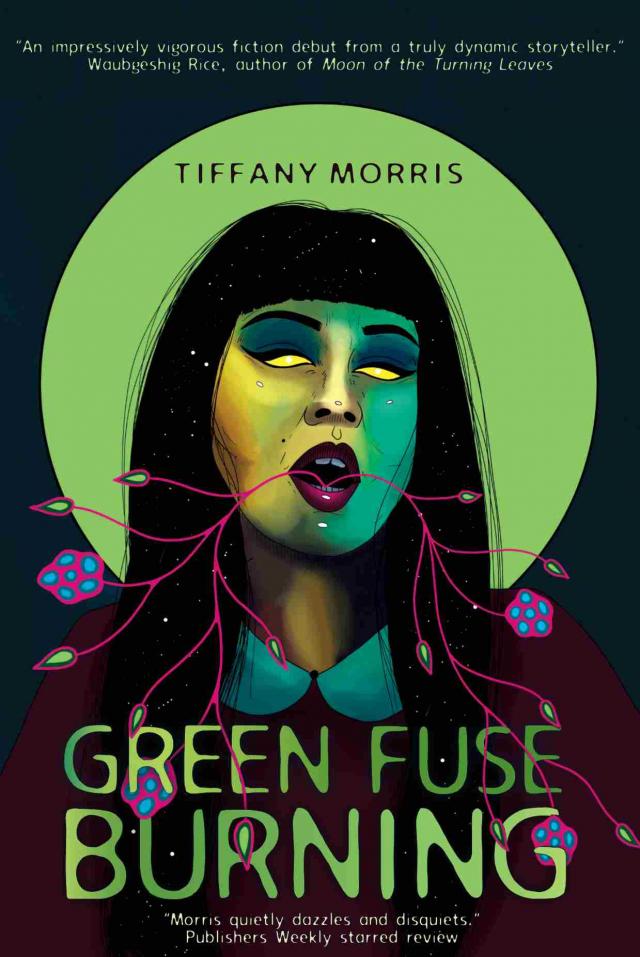


Advance Praise
“Green Fuse Burning is an impressively vigorous fiction debut from a truly dynamic storyteller. Tiffany Morris has laid out a concise and creepy tale that mesmerizes as it weaves through several realms, from the tangible to the spiritual. I was captivated by the looming mystery and the striking imagery that carried me like a current to the story’s monumental resolution. This book is a must-read in new speculative fiction!”
Waubgeshig Rice, author of Moon of the Turning Leaves
“In this Indigenous swampcore novella, Tiffany Morris has invented a full, complete, yet simple and graspable language that expresses how I feel as a creature in this particular universe born from the dirt of this particular planet. She masterfully reclaims cosmic horror from its white tradition, and that’s so important because the genre has big problems™️ with its philosophy, not just its heritage. I’m in such awe of her execution and the quietness and humbleness of the story, how she spins it all into something meaningful and new. Green Fuse Burning is an astonishing work that processes personal and planetary grief, and leads the reader through a viscerally healing experience. Thank you for this witchery, Tiffany.”
Joe Koch, author of The Wingspan of Severed Hands
“Lush and innovative. You can tell from the start that you’re in for something different. Green Fuse Burning digs its fingers through fertile layers of ecology, grief, and twin apocalypses to explore transformative death with a beauty both isolating and unsettling.”
Hailey Piper, Bram Stoker award-winning author of Queen of Teeth
“A verdant alienation seeps through every page as Morris reimagines the possibilities of decay, a desperate isolation scouring the mind to reveal a torrid, seething strangeness beneath, the inevitable reckoning gathering its strength below the calm surface of the pond.”
Andrew F. Sullivan, author of The Marigold and The Handiman Method
“An unbridled examination of place and the puzzle of finding one’s purpose, Green Fuse Burning simmers until it explodes. An introspective look at how nature can connect and inspire that’s filled to the brim with feeling.”
Steve Stred, 2x Splatterpunk nominated author of Mastodon, Churn the Soil and The Color of Melancholy
“In Tiffany Morris’s riveting eco-cosmic novella, the horrific splendor of the natural world pulls readers into the emotional labyrinth of her reconnecting Mi’kmaq protagonist. With a style both hauntingly beautiful and viscerally unsettling, Morris joins a burgeoning movement of writers reimagining cosmic horror through a nuanced Indigenous lens—surely making Lovecraft spin in his grave. Green Fuse Burning is a compelling portrait of grief and identity unfurled against a backdrop of ineffable beauty and lurking dread. Morris’s storytelling thrives in this tension between the gorgeous and the grotesque and invites readers on a haunting journey through the tangled veins of human emotion and the dark, enigmatic heart of nature itself.”
Shane Hawk, co-editor of Never Whistle at Night
Some readers may require content warnings for parental death, suicidal ideation, animal death/gore, and explicit sex.
For those in the swamplands.
she sings her fear, hope frailer than
an abandoned nest
— Terese Mason Pierre, “The Weavers”
The force that through the green fuse drives the flower
Drives my green age; that blasts the roots of trees
Is my destroyer.
— Dylan Thomas
Devastation of Light: The Recovered Paintings of Rita Francis
Gallery Autochthone is proud to present Devastation of Light: The Recovered Paintings of Rita Francis. Recovered from the artist’s cabin following a mysterious disappearance, the six paintings presented here demonstrate a watershed moment in Francis’s burgeoning career. The urban Mi’kmaw landscape painter departs from the muted tones of her previous work, leaning harder into the abstract elements of her style, including inspiration from her cultural heritage. Moving deeper into an experimental mode, her mixed-media acrylic work utilizes elements of the pond where she was a resident. Repurposing sticks, moss, and other detritus from the pond’s surroundings to reconfigure the viewer’s orientation within the landscape, Francis challenges the landscape tradition itself. The startling and mysterious pieces shown here are designed to cajole, disturb, and interrogate the viewer, showing us everything from Mi’kmaw symbols to tortured figures contending with the land in new ways. Pain strikes through the alienation and intimacy of each painting’s relationship to the land. In these paintings we see the murky, urgent depths of a woman’s spiritual journey into the swamplands of uncertainty.
1
The Pond When the Moon Threw No Light
24” x 36”
Acrylic on canvas
The first in the series, The Pond When the Moon Threw No Light is a charcoal-hued grisaille: the dark grey brushstrokes are thickly layered on the canvas, creating a deep, mossy texture, surprising the viewer with the revelation that this piece contains no alien elements—you would almost think the moss had formed on the work itself. The darkness of night on the pond is illuminated with small strokes of gold and white, surrounding pale humanoid figures that are barely discernible. Francis depicts these figures in faint outlines, descending, ghost-like, into the black pool of the water. The mysterious figures seem unaware of the viewer’s gaze, and the overall impact is one of voyeuristic unease. The interaction between the human and other elements of the natural world is unsettled here, punctuating the darkness only with the movement into water and the viewer’s sense of witness.
Dark shining night sighed into the expanse of the pond. The Frog Croaking Moon, Squoljikus, was a faint sliver humming into the sky above. It threw no light.
Rita watched the running silhouettes from the pitch-black shadow of the cabin bedroom. She’d awakened to the crunch of footsteps on gravel and stumbled, sweaty and confused, from the rickety single bed. Footfalls rushed the spring peepers and bullfrogs into silence. Her own heavy breathing surrounded her, almost obscuring soft movements down the bank: splashing deep into the green-brown water.
Pain pulsed up her leg from the stumble. She crouched at the window, breathing dust and mildew as she squinted over the windowpane and into the distance. Technically, there was no reason to stay hidden in the bedroom, but there was also no reason for anyone to be at the isolated pond, or near this small cabin — let alone for people to be in the water in the middle of the night.
A bloated, pale body flashed through her mind, conjured from the passive consumption of a thousand police procedurals screaming blue light into her parents’ living room. She fumbled toward the bedside table, feeling for the cool glass of her phone. No texts had sent or come through since she’d arrived at the cabin, but just in case — just in case — she should check. Her hand shook and she nearly dropped the phone. When she hit the button she grimaced, waiting for light that didn’t come. Her phone was dead. From outside the window came a loud thump, followed by dragging, grunting.
A body. A limp assembly of limbs, heavy with the absence of story. Of course. It had to be a body. Rita shut her eyes tight. It couldn’t be held off; the memory was a wave destined to crash over her. It always happened this way — a procession, a rosary of grief, focusing and shuddering through her memory: her father in his coffin. The eagle feather in his hands. His eyes — she remembered, with a lurch in her gut — were sewn shut. No matter how much she’d tried to forget that fact, she couldn’t forget anything she’d learned about the embalming process in late-night YouTube spirals, her wakefulness burning electric with the fear of her own mortality.
Incense and murmured prayers had filled the thick basement air of the reserve church. Prayers her tongue couldn’t shape. She had neither the full grasp of the Mi’kmaw language at her disposal, nor the religious background of her cousins or her brother. Maybe if she had grown up on the rez it would be different; the community was ninety percent Catholic, eight percent Baha’i, and traditional in their own admixtures. It was a place where prayer could be shaped by any number of languages, few of which spoke to her own soul, or her life, or her memories.
The trauma rhythm continued its perfect torture: the same flashbacks came in their expected sequence. The hospital looming in the distance. The ICU with its bodies stretched out in beds, some destined for death despite everyone’s efforts, prayers, begging palms held open to the sky.
What could she do? Rita exhaled again, a slow and deliberate attempt at calm taken from a history of therapy appointments where bored counsellors recommended breathing techniques, strategies for noticing her own embodiment through body scans, stretches, any number of ways to contend with the weight of her being. The perfect blackness of night in the cabin danced swirls in her adjusting eyes as she breathed, steadying only when the sounds outside stopped. Crouching at the window, she stared as silence cut through the dark. She couldn’t see anything out there.
Maybe this wasn’t real. Hallucination or not, she could ignore it, crawl back under the covers. If whatever was going on out there was real, it would not be worth the risk of being seen. It could be people out for a midnight swim, people throwing anything into the pond — not necessarily a body — and whatever happened in this nowhere town was none of her business, right? It could be some weird local thing, she didn’t know. Possibly no one had noticed her rented car, itself black and tucked beside the cabin in the black night. She could check the locks, go back to bed, forget all of this.
She could be d reaming. She’d sleepwalked as a kid, hallucinated all manner of things, found herself waking up on the porch some mornings with muddy feet and the imprint of grass on her arms, impressions of an unknown hour. There was even the one night, when she’d awakened to a gunshot, the sounds of screaming that rose and fell and then died. In the morning she’d told her mother about it in a trembling voice. Her mother had laughed. She hadn’t heard anything. Rita must have been dreaming. No one else had heard anything, her mother had said, and surely such a thing would cause a ruckus, would wake the whole neighborhood, wouldn’t it? For the rest of the week Rita had scanned the newspaper but found nothing.
“Well, t’us, vivid dreams are a good thing for an artist to have,” her mother reassured her. “Lots of creative people get inspiration that way.”
The Mi’kmaw language always sounded weird coming from her mother, even though her mother was half Mi’kmaw. She had been estranged from that side of her family for years and wouldn’t tell Rita why, wouldn’t share any knowledge with her other than a few words or phrases. She was much more into telling Rita how she should behave and what convoluted beauty rituals could improve her appearance. Rita knew her mother wouldn’t want her to paint the grisly crime scene she’d sworn she witnessed. She’d prefer the kind of dreams that etch happiness into waking hours, the kind that immerse the dreamer in warmth like bathwater.
But when the nightmares continued, her mother took her to the doctor, then a therapist, and neither were able to pin down what was wrong with her. A vivid imagination, Dr. Rose had finally said, and when Rita looked over at her mother she saw the gleam of smug satisfaction in her eyes. In that moment, Rita knew her mother would never care as much about her mental health as she did about being right. She mourned what her life could have been if her mother had been able to open up to her more, to see Rita for who she really was and not just who she wanted her to be: not a doll, or a mirror, or a blank canvas onto which she could project her hangups, but an imperfect child. If those things had been different then maybe Rita’s dreaming would have taken the shape of sunlight, beaches, calm light-dappled days in the fresh air. Those were the dreams that begged to be made real, not the scenes that haunted her well into adulthood.
Rita crawled back to the bed. The floor was cold on her hands and knees, the sheets soft and smelling vaguely of bleach and fresh air. It would be better — if something untoward were really happening — if she pretended that she wasn’t there. Her back pressed to the mattress, she stared into the black expanse of ceiling above her and willed her body to relax. She tensed her feet then released the tension. A body scan meditation, like her old therapist had instructed. She moved her focus up her body: tense, relax, tense, relax. One body part at a time. A dismembered self slowly made whole.
This was just like her, right? Just like her to avoid the problem, any problem, to do nothing and hope it would go away. But this was a dream. It had to be.
She listened, her limbs wire-tight. The footsteps and splashing had faded, but their echoes thrummed through her. She would need to do more than one body scan meditation tonight. Outside there was no sound of doors opened or closed, no motor, no rattling gravel from a retreating car. As the silence stretched into the night, she had no way of knowing how much time had gone by. The thing to do was to fall asleep again. She was never good at waking herself up; this was the only option, to close her eyes and drift away. What was it to fall asleep in a dream? Nothing piled upon nothing. Immersion into a waiting oblivion.
She closed her eyes and the darkness, its silence, took her with it.
A loon shrieked a mournful call over the water. The sound was unmistakable, but impossible — loons typically lived in ponds only in the summer, to nest and raise their young. She hoped she might find the bird, do some preliminary sketches, and paint it. Landscape painting had come so naturally to Rita, with her deep love for art and nature but with no mind for science. Ever since she was a child she would devour natural history books, absorbed in learning everything she could about local species, climate, and ecology, thrilled to name and know the world around her. The odd time when she would visit her father, he would teach her the Mi’kmaw names, the words resonating in her subconscious, nesting there for later understanding.
In the dim morning light of the cabin bedroom, Rita squinted, listening for the loon. Now that the climate was in chaos, now that the Atlantic coast fell to flame and choked on wildfire smoke earlier and earlier each summer, the rhythms were off. The sweltering, stifling spring humidity had tricked all life, disrupting the cycles that had existed from time immemorial.
Everything was tainted, including her.
Her hands shook a little as Rita willed the memory of the previous night away and pulled up the stiff, dirty window. The paint peeled at the edges, a dull white that revealed soft wood. The cabin was shabby chic, or so the listing had said. In these cases, chic was always a relative term. But that was okay for her purposes. The rustic nature of the place made people think it was authentic, whatever that meant.
The humid air grasped at her throat as the loon’s call grew louder. Rita scanned the pond’s placid waters, trying to pinpoint the bird’s silhouette in the distance. The fog rolled thick over the horizon, smothering the tops of the surrounding trees. Somewhere along the shoreline — or in some hidden inlet — Rita could hear splashing, a choking sound of distress. An animal noise — or fear beyond language. Was something out on the water? Something from the night before? The loon’s call — maybe an echo from her troubled dreams — trembled over the expanse of the pond and faded again into quiet.
Sweat clung to the small of her back. Rita pulled her white t-shirt from her skin and scratched a mosquito bite on her arm, feeling suddenly alone. Sure, that was the point: space to concentrate on her painting, to make the most of the grant she’d been awarded. But Molly was right; her loneliness was less sharp out here in the country, in a place where everything was both solitary and part of something bigger than itself. She might have romanticized the residency a little, imagining herself painting in swaths of golden light each day, reading by candlelight, heating her food on a woodstove. The pond was the biggest in the province, a few kilometres around, surrounded by forest and trail. Surely it could offer a lot in the way of inspiration, especially for a landscape painter.
Molly hadn’t texted her since she’d arrived, but who knew, maybe her texts just hadn’t gone through. The reception was spotty. Rita ignored the fear that snapped a rabbit snare in her gut. The phone was charging now, and she tried not to be bothered by its silence, the absence of spoil from a futile hunt.
On a shelf in the bedroom, Rita found an old battery-operated radio and switched it on. Success: the battery still had charge. She turned the dial, scanning the band. A country station: twangy guitar. Another country station: twangy auto-tune. Rita wrinkled her nose. She could measure city limits by the prevalence of country stations. Her fingers rolled over the dial, the lined metal reminding her of childhood afternoons playing with her grandparents’ weird old-timey antiques. Static, static, static, faint conversations cut through with more static, forming languages that were not comprehensible as English or French, sounding more like rustling leaves and sighs. Not even public radio reached this far into the country. Rita switched the radio off, still lonely for human voices. She should’ve loaded her phone with podcasts.
She would have to go into Àite an Lòin. She tripped over the syllables in her head, imagining her tongue twisting over the “original Gaelic” name for the town, trying to remember the pronunciation. Rita had rolled her eyes when Molly mentioned the naming initiative — surely they could have looked into the original Mi’kmaw name before going straight to Scottish Gaelic? But she’d tried to learn it in earnest anyway.
She would have to step outside the strange melancholy of the cabin and venture into the two-cow town. There was a gas station and there would be people. She could bring up the dream — or not-dream — casually ask if anyone had been around the night before, mention that she’d heard people around the pond, in the water. But nothing that would arouse suspicion. Certainly nothing about bodies being dragged. She would get a feel for the tiny town she had blown through on her way to the residency, admiring the blur of evergreens weeping the smell of sap through her open window, disrupting sky slung grey, then meadow, field, farm.






