Backstitched and stabbed, p.1
Backstitched and Stabbed, page 1


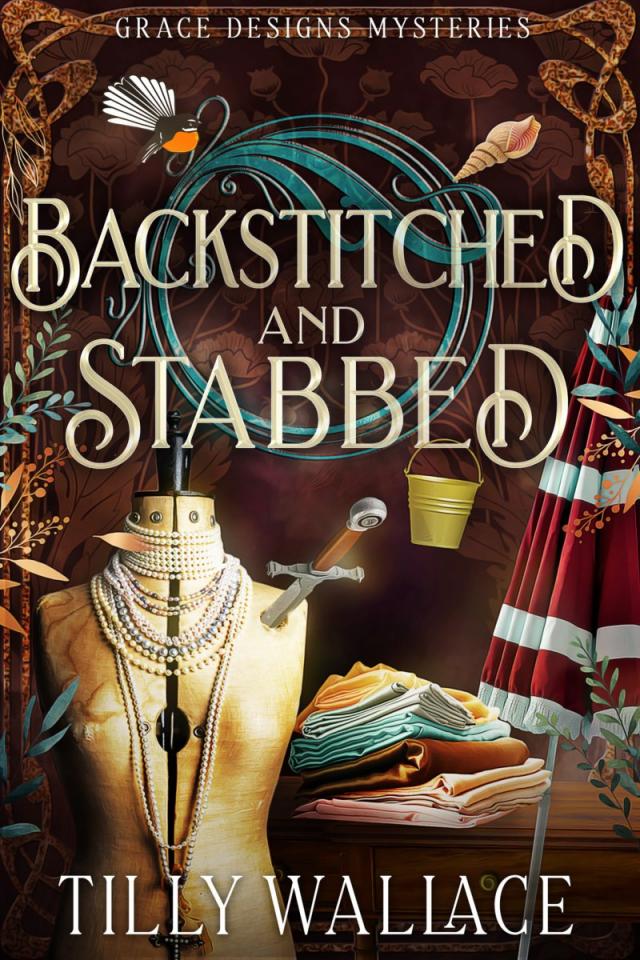
Backstitched and Stabbed
GRACE DESIGNS MYSTERIES
BOOK TWO
TILLY WALLACE
Copyright © 2023 by Tilly Wallace
All rights reserved.
No part of this book may be reproduced in any form or by any electronic or mechanical means, including information storage and retrieval systems, without written permission from the author, except for the use of brief quotations in a book review.
ePub ISBN: 978-1-7385845-4-3
v11082023
Cover design by Melody Simmons
Editing Kat's Literary Services
To be the first to hear about Tilly’s new releases and exclusive offers, sign up at:
https://www.tillywallace.com/newsletter
Contents
Chapter 1
Chapter 2
Chapter 3
Chapter 4
Chapter 5
Chapter 6
Chapter 7
Chapter 8
Chapter 9
Chapter 10
Chapter 11
Chapter 12
Chapter 13
Chapter 14
Chapter 15
Chapter 16
Chapter 17
Chapter 18
Chapter 19
Chapter 20
Author’s Historical Notes
Also by Tilly Wallace
About the Author
Blurb
BACKSTITCHED AND STABBED
The only thing worse than wet woollen togs is a knife in the back…
As the Kiwi summer draws to a close, a family outing to the beach takes a deadly turn when a lifeless body washes up on shore. Grace is devastated to recognise the victim, Ricky, who worked in her friend’s bakery. But when the supposed drowning victim is rolled over, a shocking truth is revealed—he was murdered.
Drawn into finding the murderer of the cheerful baker, Grace picks at the tangled web of secrets that surrounded Ricky. The man lived a double, or even triple, life. But which version of him had provoked the fatal encounter? Grace and her friends must find the person responsible before another life is lost to the same tide of violence that claimed Ricky.
The second instalment in the Grace Designs mystery series, about a seamstress turned sleuth in Wellington, New Zealand at the dawn of the 1920s.
Chapter One
Saturday, 28 February 1920.
“If you don’t hold still, we will miss the ferry.” I swear that the ability of a small child to hold still, is inversely related to how much time you have.
Theo, my son, had inherited his father’s pale skin and as a consequence, burned easily. As he squirmed to rush for the motorcar waiting to take us to the wharf, I was trying to ensure his hat was tightly wedged on his head and the string tied securely under his chin. In the end, I won. But only because Dad blocked the door and pointed to the hat on his head. If Grandpa wore one to the beach, apparently it was acceptable.
Outside in the narrow lane, Joseph sat at the wheel of a large travelling vehicle. For a moment, I wondered how he had manoeuvred it there, but it spoke to his skill that he most likely reversed up around the corner to get it into place. The vehicle was kindly loaned to us for the short trip by my mentor, Mrs Cooper, on the condition that Joseph helps her driver wash it afterwards. My cousin had moments of lingering guilt after recent events, even though I reassured him there was no bad blood between us. He had an intense loyalty to his job as a police officer and Detective Archer, but I had smudged the edges.
They say you can’t beat Wellington on a good day, and today was a top one. The gusty winds had dropped, the sky didn’t have a cloud for miles, and despite the early hour, the warmth promised that the last day of summer would be a scorcher. Determined to take advantage of the predicted glorious weekend, we decided yesterday to head to Days Bay for a picnic. Situated across the harbour, the beach was a popular spot for Wellingtonians wanting to relax, go for a swim, or build a sandcastle.
Sam and her mother joined us and we had an assortment of baskets containing our swimsuits, towels, books, toys to entertain Theo, and most importantly…our lunch. As a point of honour, the Kostas women brought enough food with them to feed a family of twenty, not the five of us. The only things we lacked were chairs and an umbrella, but we would hire those when we reached our destination.
Dad gripped the handle of his cane, and I slipped my arm through his as Theo raced to leap into the open-top motorcar.
“Foot giving you some pain?” I asked as we stepped outside.
He locked the door and gave me a lopsided grin. “Damn toes are itchy. I’m looking forward to a paddle in the ocean. That’ll satisfy them.”
Dad suffered with pains in the missing limb, which seemed unfair to me. How could an appendage that was no longer attached feel anything? Yet I had heard of returned soldiers who experienced the same phenomenon. For Dad, the only thing that relieved the symptoms was immersing the phantom foot in the salty water. At times, I wondered if my father was part sea creature, such was his love of the ocean and his need to be near it.
A short ride later, Joseph dropped us close to the wharf. Sadly, it seemed most of Wellington had the same idea as us, and we were all crammed onto the wharf to catch the steamer across the water. I kept a tight grip on Theo’s hand, not wanting to lose him in the crowd. The four adults formed a tight cluster with Theo in the middle, which meant his view of events was restricted to waistbands and bottoms.
Thankfully, we didn’t have to wait too long before the crowd surged forward to pile onto the Duchess. The steamer could hold over 1,000 passengers, and I was convinced there were at least that many, if not more, all seeking to enjoy the last days of summer. Dad and I insisted on sitting up on deck, which made Sam grumble.
“It’s all right for you Sullivans with salt in your veins. Some of us were born to stay on land,” she muttered as she sat with her back to the water.
“You’re half-Greek, and your dad grew up in a fishing village.” I nudged her.
“I inherited mum’s land-loving traits.” Sam was smartly dressed in pale linen trousers, a white short-sleeved shirt, and a straw boater. She would have looked at home lounging on an expensive yacht sailing the Mediterranean Sea.
“Would you rather be wedged in the cabin with sweaty land lubbers who vomit at the slightest wave?” We Sullivans were exhilarated by rough waves. The action of the ocean made us come alive.
Sam grimaced at the idea of the smelly interior below. “Perhaps not.”
Theo clung to the rail to watch the water race past the hull and laughed when spray dotted across his face. I closed my eyes, enjoying the gentle up and down motion of the steamer that made others rush to the rail for quite a different reason than enjoyment.
As I basked in the moment, a pressing situation tapped for my attention. In the rush of getting out the door, my motherly instincts made sure Theo had been to the toilet, but I completely forgot about my own needs.
“I need to go to the bathroom,” I whispered to Sam before getting to my feet. There would still be three sets of eyes to keep track of Theo.
The narrow stairs took me below deck and to the tiny bathroom cubicles. The rank odour of sweat permeated the stuffy air. Polite smiles were exchanged among those waiting, but thankfully it wasn’t too long before it was my turn. The oiled wooden door opened and a familiar face stepped out, Ricky Hammond. The young man worked in the Kostas Bakery. He appeared to be suffering from a touch of seasickness, with a sheen to his face and a slight green undertone to his skin.
“Hello, Ricky,” I called out as he held the door open.
“Mrs Devine.” His eyes widened until they seemed all black pupils. “I have wanted to ask you, don’t you have a relative in the police?”
“Oh, yes. Joseph, my cousin, is a constable.” What an odd question.
“There’s a queue, you know!” someone yelled out from behind us.
“I’ll find you later,” he murmured.
With an apologetic smile at having to cut the small talk short, I reached out to grab the door as the ship hit a wave and rolled to starboard.
Ricky flung out an arm to steady himself, his bare skin grazing across mine.
I hurried to step into the toilet and slam the door as a transferred memory leapt up my arm and burst into my mind.
‘You don’t betray your team,’ he spat out in short, angry syllables. A stubby finger attached to a meaty hand pointed in my face with each one.
Sweat beaded between my shoulder blades and fear trickled down my spine. I licked my lips but my mouth was so dry, there was no relief to be had. How did he know? ‘Teams change. Some players retire. Others move to different games.’
‘No one leaves unless I let you. Remember what we do to traitors.’
It took several breaths to shake off the memory. There was only one thing that you don’t betray your team could mean and that might press on the young man’s mind. Given the New Zealand obsession with rugby, he had probably backed the provincial Manawatu team over the Wellington Lions. Or, horror, perhaps Ricky was part Australian and dared to back their team over the Invincibles.
Someone banged on the door. “Are you all right in there?” an older male voice asked.
How rude to interrupt someone while on the loo. My business taken care of, I hurried out.
“So sorry,” I murmured to the grumpy man looming over the door as though he guarded it to ensure he was next.
Back up on deck, I dropped beside Sam. The bay was visible already and soon the steamer would slow for its approach. Then we would be packed like sardines for the walk along the jetty. “I saw Ricky below.”
“I don’t keep him chained by the oven like Cinderella. He’s allowed time off.” She had one hand on her hat, not relying on the tightness of the band to keep it secure on her head.
“He didn’t look well.” The memory would stay tucked inside me for now. Out on the open deck, anyone could hear our conversation, and I wanted time to mull over what it meant. Most probably nothing. But usually, the memories that thrust themselves into me meant the other person was in some sort of pickle, and I was supposed to do something about it. Later, when Theo was playing in the sand and Dad was snoozing with an open book on his chest, I would seek Sam’s opinion about what I saw.
It didn’t take too long before the steamer sounded its horn to alert everyone to our imminent arrival. Although how anyone could be curled up inside and miss our journey, I didn’t know. We waited for the bulk of people to rush for the exit before we picked up our baskets. Dad leaned heavily on his cane today, as we walked along the salt-laden timbers of the wharf at a slow pace. Excitable children surged past us, and Theo gave them a longing look and tugged on my hand.
“It’s rude to run off and leave Poppa behind, Theo,” I reminded him.
He shot me a look that was part-apologetic and part-pure longing. It took another thirty seconds to reach the end of the jetty, a lifetime to an impatient four-year-old. Following Dad’s directions, we staked out our spot on the sand near a stand of trees. We weren’t too far from the Pavilion, but what Theo considered a dumb distance from the water.
Dad chuckled and pointed to the people spreading blankets and digging umbrellas into the sand only ten feet from the water’s edge. “The tide is coming in, Theo. You wait, by lunchtime we’ll have the best spot and all those poor sods will be dragging everything up to the grass.”
Sam and I walked up to the Pavilion while Dad and Mrs Kostas spread out our blankets and set the baskets to weigh down the corners. We hired two deck chairs and a large striped umbrella and carried them back to our spot. Then we took turns to use the changing rooms. I was very excited to show off my new swimsuit. Made of navy wool with a smart white trim, it had shorts that stopped above my knee and an overdress on top. Fashion dictated stockings and swimming shoes as well, but in this case, I decided to be practical. It was simply too warm and I wanted to bury my bare toes in the golden sand.
“You rebel. I’ll have you wearing trousers every day, yet,” Sam said as we exited the busy shed.
She wore a similar outfit to mine but in red. The men’s costume was far too scandalous, even for my brave friend. Neither of us wore soft-soled swimming shoes, and I let out a sigh as heated sand flicked over my toes.
Dad modelled a woollen one-piece in wide grey and white horizontal stripes that I had made for him.
“Can I go for a swim, Mum?” Theo wheedled. He wore a swimsuit of the same grey stripe as Dad, although with a smaller torso, his had far fewer stripes!
“I’ll stay here and guard lunch.” Mrs Kostas settled in the deckchair and under the shade of the umbrella.
“Are you sure Mum, you’d normally love a swim?” Sam asked her mother.
“Later, love. I have a book I want to finish first.” She patted the large tome on her lap.
“Come on then, Theo.” Taking his hand (regardless of how he stuck his lip out), we strolled through the crowd of cheerful people to the water’s edge.
Dad hopped beside us, having left both his wooden foot and cane behind. He could use his stump to balance (having lost the foot at the ankle) but it gave him a lopsided gait like a boat being tossed in a heavy sea.
Worry gnawed at me, wondering if he would be all right, but I’d never insult him by saying that out loud. Instead, I asked, “Off for a swim?”
“Of course.” Dad grinned and ambled out deeper. His odd gait unnoticeable once the water submerged his stump and took his weight for him. Half-selkie that he was, he soon dived under a wave and with a few powerful strokes, he headed out to deeper water.
“I wish I could swim like Poppa.” Theo tugged me out into the water.
“Listen during your lessons, instead of holding your breath to sit at the bottom of the pool, and you soon will.” I tried to appear stern, but it was difficult. The teacher nearly had a heart attack the first time he did a head count and came up one short. Theo had sat clutching his knees on the bottom of the pool. That child could hold his breath for a long time. As I discovered during some impressive tantrums he threw as a two-year-old.
Once he had given his solemn promise not to go past his little knees, I agreed to let go of his hand. Soon, a couple of friends joined him, and the boys splashed each other and ran back and forth in front of watchful mothers.
Sam stood beside me and we chatted while Theo played. Another familiar face walked past.
“Two of my favourite girls!” Harry stopped in front of us. His wiry physique was displayed in a blue and yellow striped costume. His eyes were hidden behind dark sunglasses and a straw hat shaded his face.
“Hello, you,” Sam said.
Seeing Harry reminded me of who else I saw earlier. “I saw Ricky on the steamer. Are you lads out for a day in the sun?”
Harry’s wide smile dropped away. “We boarded the steamer together. But I fear he suffered cold feet when he realised the other lads weren’t coming with us. I shall track him down later. He simply must see how magnificent I look in this outfit.”
“He probably spotted someone else he knows and stopped for a chat.” It only took a matter of minutes for Theo to find school chums among the beachgoers, and I doubt age changed that ability. A personable lad like Ricky probably encountered many friends between water and sand.
“Why don’t you join us for lunch? We have plenty of food, and he might be more comfortable in a group he knows.” Sam gestured back to where her mother sat.
“Will do.” Harry saluted and then waded out.
“Expecting Ricky to spend his day off with his employer?” I nudged Sam with my elbow.
“I’m not a monster and can carry a conversation on a wide range of topics I’ll have you know.” Sam huffed, but it was all bluff. Under her tough skin, she hid the softest heart.
Time flowed with the ebb of the tide and before we knew it, mothers called to children and summoned them to lunch. I reclaimed Theo and as we settled on the blanket, Dad emerged from the water and hobbled back up to our spot. He briskly rubbed off the salt water with his towel, then dropped into the deckchair.
Harry joined us. Alone.
Sam raised an eyebrow, and we shared a look. Poor chap. It looked like his romance was doomed before it left the starting block.
Chapter Two
“Sandwich?” Mrs Kostas held a plate with a selection of crustless club sandwiches under Harry’s nose.
We’d soon have his heartache submerged by heartburn with the number of cakes and sweet treats we could shovel down him. I hadn’t spent a lot of time in Harry’s company and enjoyed his conversation over lunch. While he worked as a librarian at Victoria University, he had a critical eye for fashion and kept up a biting critique of the women around us.
“Can I have a donkey ride, please?” Theo pointed with a sticky finger at the animal walking back and forth.
“Of course. But finish your lunch first.” The donkeys had the tolerance of saints, as excited children bounced in the saddle and handlers trod the same path back and forth across the beach.
We chatted and laughed and ate until we were all as stuffed as after Christmas dinner. Over at the Pavilion, musicians played from the deep verandah and people gathered to listen and sing the words to songs they knew. Theo had his much longed-for donkey ride, only to complain that the creature was too slow and he much preferred the leggy hacks on his uncle’s farm. My mothering instinct had a slight moment of panic at his need for speed, and I imagined him charging around the roads on the bicycle I had bought him for his birthday.